
Soundproofing in Malaysia: Walls, Ceilings and Floors That Actually Reduce Noise
Noise complaints are one of the most common frustrations in Malaysian condo and landed living - a noisy neighbour through a party wall, footsteps from the unit upstairs, or traffic rumbling through a bedroom window facing a main road. My Reno Service handles soundproofing for homes, apartments and condos across KL, Selangor and the wider Klang Valley, from a single problem wall to a fully treated home studio.
The right solution depends on what's making the noise. Voices, TVs and traffic behave very differently from footsteps or dragged furniture. Treat the wrong problem, and you'll usually end up disappointed.
Tell us what's happening and send a few photos of the room or wall if you can - we'll help you understand what's realistic before you commit to a treatment plan.
What Does Soundproofing Actually Involve?
Soundproofing covers any work done to reduce how much sound passes between spaces - through a shared wall, a ceiling, a floor, or gaps around doors and windows. It's a different goal from acoustic treatment, which improves how a room sounds internally (reducing echo) instead of blocking sound from entering or leaving.
The single most important distinction is between airborne noise and impact noise. Airborne noise - voices, television, traffic, barking dogs - travels through the air and is treated by adding mass and sealing gaps. Impact noise - footsteps, dragged furniture, dropped objects - travels through the structure itself, and needs a different approach entirely, usually involving decoupling or isolation rather than just adding weight.
A lot of people end up disappointed because they're solving the wrong problem. Foam panels are a good example - they reduce echo inside a room, but do very little to stop sound getting through a wall. Getting the right diagnosis of what's actually happening is the first step, before any material gets chosen.
Which Soundproofing Problem Do You Have?
If you already know what's bothering you, here's roughly where to start before reading the full breakdown below.
Noisy neighbours through a shared wall
This is airborne noise, typically the most straightforward to treat - adding mass and decoupling to the party wall usually brings a noticeable improvement.
Footsteps from the unit upstairs
This is impact noise. It's best treated at the source - the floor above - not only from your ceiling. Ceiling treatment helps, but rarely solves it completely on its own.
Traffic or road noise through windows
If your bedroom faces a busy road, don't assume the wall is the problem - in most homes, the window is where more of the noise gets in. Door and window sealing, heavier glazing or acoustic curtains are usually the fix.
Want a quiet home studio or media room
This usually means treating an entire room - walls, ceiling, floor and door - not just a single surface, and is best planned as its own project.
Benefits of Soundproofing Your Home
Soundproofing is easy to keep putting off since it doesn't change how a room looks, but it affects daily life more than most renovation work.
Better sleep and lower stress
Constant low-level noise, even below the threshold of being consciously annoying, is linked to poorer sleep quality and elevated stress - a quieter bedroom is one of the more underrated renovation upgrades.
Privacy for calls and remote work
A treated home office means video calls and phone conversations don't carry into the rest of the unit, and vice versa.
A usable home studio or media room
Proper treatment is what makes a home studio, jam room or dedicated home theatre workable in a residential building without becoming a source of complaints.
Fewer disputes with neighbours
Noise is one of the most common sources of friction in condo living. Treating your side of a shared wall or floor is a practical way to reduce it, even when the noise source is next door.
Better resale and rental appeal
A noticeably quiet unit, particularly one facing a busy road or in a building with known noise issues, can be a point of difference for buyers and tenants, though it's one factor among many in a sale or rental decision.
More usable rooms
A soundproofed room near a noisy road or shared wall can go from being avoided to being one of the most-used spaces in the home.
Soundproofing Services We Handle
Soundproofing scope ranges from sealing a single door to fully treating a room. Most projects fall into one of these categories.
Party wall / wall treatment
Best for: noisy neighbours, shared walls in condos and terrace houses. What's involved depends a lot on how the existing wall is built and how easy it is to work on.
Ceiling impact-noise treatment
Best for: footsteps and impact noise from the unit above. It reduces the problem, though it rarely eliminates it without treatment upstairs as well.
Floor treatment / floating floor
Best for: reducing the noise your household sends down to the unit below. It's often paired with a flooring replacement, since the underlay sits below the finish.
Door sealing & upgrade
Best for: gaps under and around doors, and hollow-core doors. It's one of the smallest jobs here, and often one of the highest-impact ones.
Window sealing & acoustic glazing
Best for: traffic and road noise. Scope ranges from resealing an existing window up to laminated or double-glazed acoustic glass.
Full room acoustic treatment
Best for: home studios, media rooms and music rooms. Walls, ceiling, floor and door are treated together as one system rather than surface by surface.
We don't publish a rate card for soundproofing, because the figures would be misleading more often than helpful. Cost swings widely with the existing construction, how many surfaces need treating, and what has to be removed and reinstated afterwards - so we quote after a site visit rather than from a table.
How Each Solution Works
A quick breakdown of what's actually involved in each type of treatment, and who it tends to suit.
Party Wall & Wall Treatment
Best for: homeowners dealing with noisy neighbours through a shared wall, in both condos and terrace or semi-D houses.
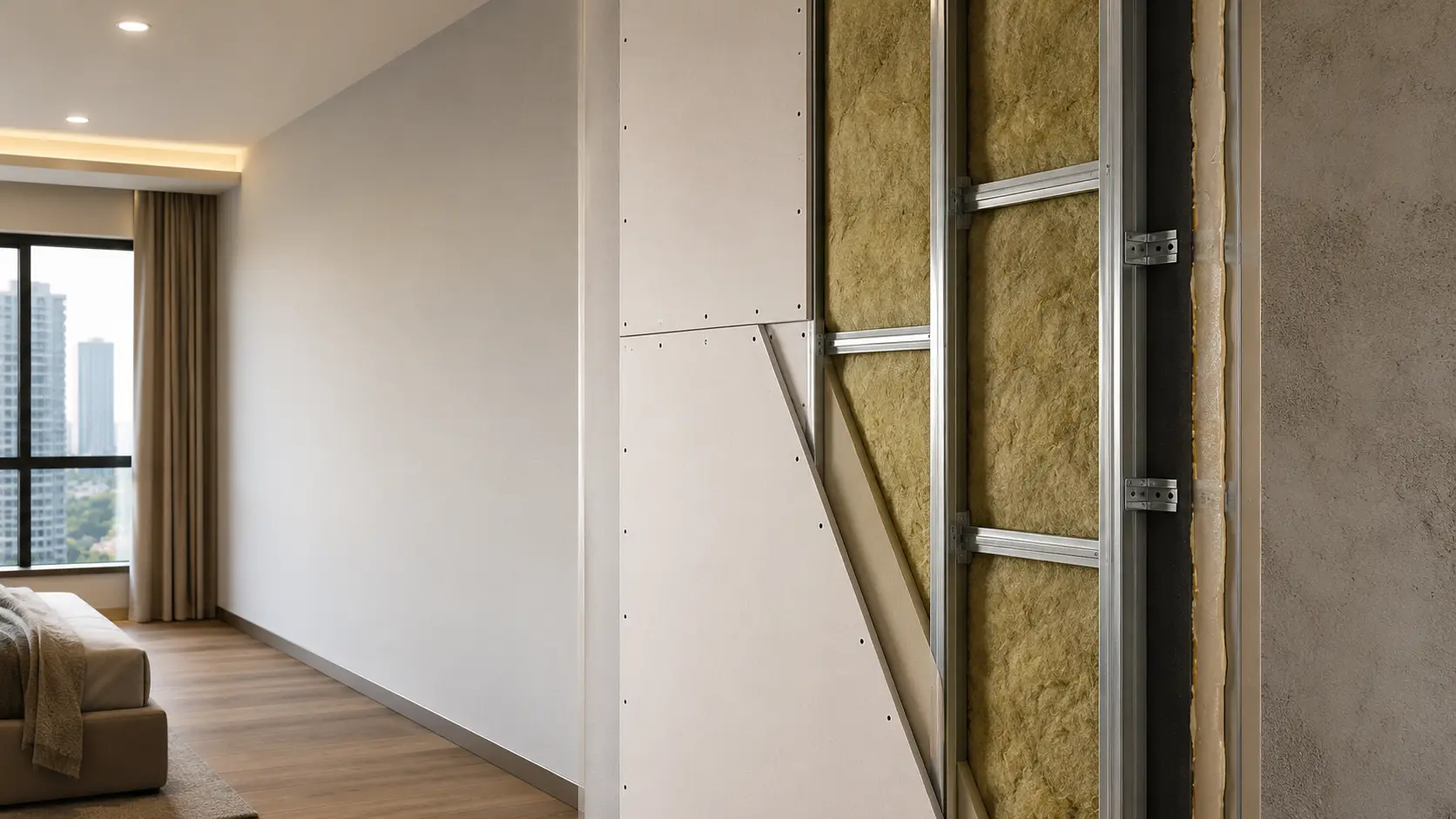
Wall treatment combines three things:
- Extra layers of dense board, for mass
- A decoupled frame or resilient channels
- Acoustic sealant around every edge
Miss one of these, and performance drops quickly.
A solid brick or block wall already has plenty of mass and usually just needs decoupled layers added; a drywall partition needs more work to get a comparable result.
Ceiling Impact-Noise Treatment
Best for: condo and apartment owners dealing with footsteps, dragged furniture or dropped objects from the unit above.
Ceiling treatment involves a decoupled, mass-loaded ceiling layer - built on resilient channels or an independent frame so it isn't rigidly connected to the structural slab above, since a rigid connection lets impact vibration travel straight through regardless of how much mass is added. This is often combined with a plaster ceiling upgrade, since both involve building down from the same slab.
Impact noise travels through the building structure itself. That's why ceiling treatment usually reduces the problem instead of eliminating it - the most effective fix is treatment at the source, a floating floor or underlay in the unit above. More on this further down the page.
Floor Treatment & Floating Floors
Best for: homeowners who want to reduce the noise their own household sends down to the unit below.
A floating floor system decouples the finished floor from the structural slab using a resilient underlay or isolation pads, reducing how much impact noise - footsteps, dropped items, dragged furniture - transfers down to the unit below.
This is often planned alongside a flooring upgrade, since the acoustic underlay sits beneath the new floor surface, whether that's SPC, laminate or tile on a mortar bed.
Door Sealing & Upgrade
Best for: hollow-core doors, visible gaps under doors, or rooms where sound leaks noticeably around the door frame.
Doors are often the weakest point in an otherwise well-treated room. A hollow-core door offers very little mass, and even a solid door loses most of its benefit if there's a visible gap underneath or no seal around the frame.
Upgrading to a solid-core door, adding an automatic door bottom seal, and weatherstripping the frame is one of the smaller jobs on this list, but often makes a bigger difference than homeowners expect for the cost.
Window Sealing & Acoustic Glazing
Best for: rooms facing busy roads, main streets or other consistent outdoor noise sources.
Standard single-pane windows and worn window seals are often the weakest point when traffic or road noise is the main complaint - upgrading the wall around a window while leaving the window itself untreated rarely solves the problem.
Options range from resealing and weatherstripping an existing window, to acoustic curtains as a lower-cost partial measure, up to laminated or double-glazed acoustic glass for the most significant improvement, which costs more but is generally the only option that makes a real difference to low-frequency traffic rumble.
Full Room Acoustic Treatment
Best for: home studios, music rooms, podcast rooms and dedicated home theatres.
A fully treated room addresses walls, ceiling, floor and door together as one system, since sound will travel through whichever surface is left untreated. This is the most involved and highest-cost soundproofing project, but also the only approach that gets close to genuine isolation instead of partial reduction.
Because this involves rebuilding surfaces from the structure outward, it's best planned as its own project. Adding it partway through an unrelated renovation rarely works well.
Common Soundproofing Materials
A few material names come up repeatedly once you start researching soundproofing. Here's roughly what each one actually does.
Acoustic mineral wool
A dense, fibrous insulation packed into the cavity between wall or ceiling layers - it absorbs sound energy rather than reflecting it, and adds useful mass at the same time.
Resilient channels
Thin metal channels that hold a new board layer slightly clear of the existing structure, so vibration can't travel straight through a rigid connection - the core of most decoupling systems.
Mass-loaded vinyl (MLV)
A dense, flexible sheet material added as an extra layer within a wall or ceiling build-up - it's heavy for its thickness, which is what makes it effective against airborne noise.
Acoustic sealant
A flexible, non-hardening sealant used at every joint and edge of a treated surface - skipping it, or using ordinary caulk instead, is one of the most common reasons treatment underperforms.
Solid-core doors
A door with a dense, filled core rather than a hollow cardboard honeycomb - one of the simplest upgrades on this list, and often the single weakest point in an otherwise treated room.
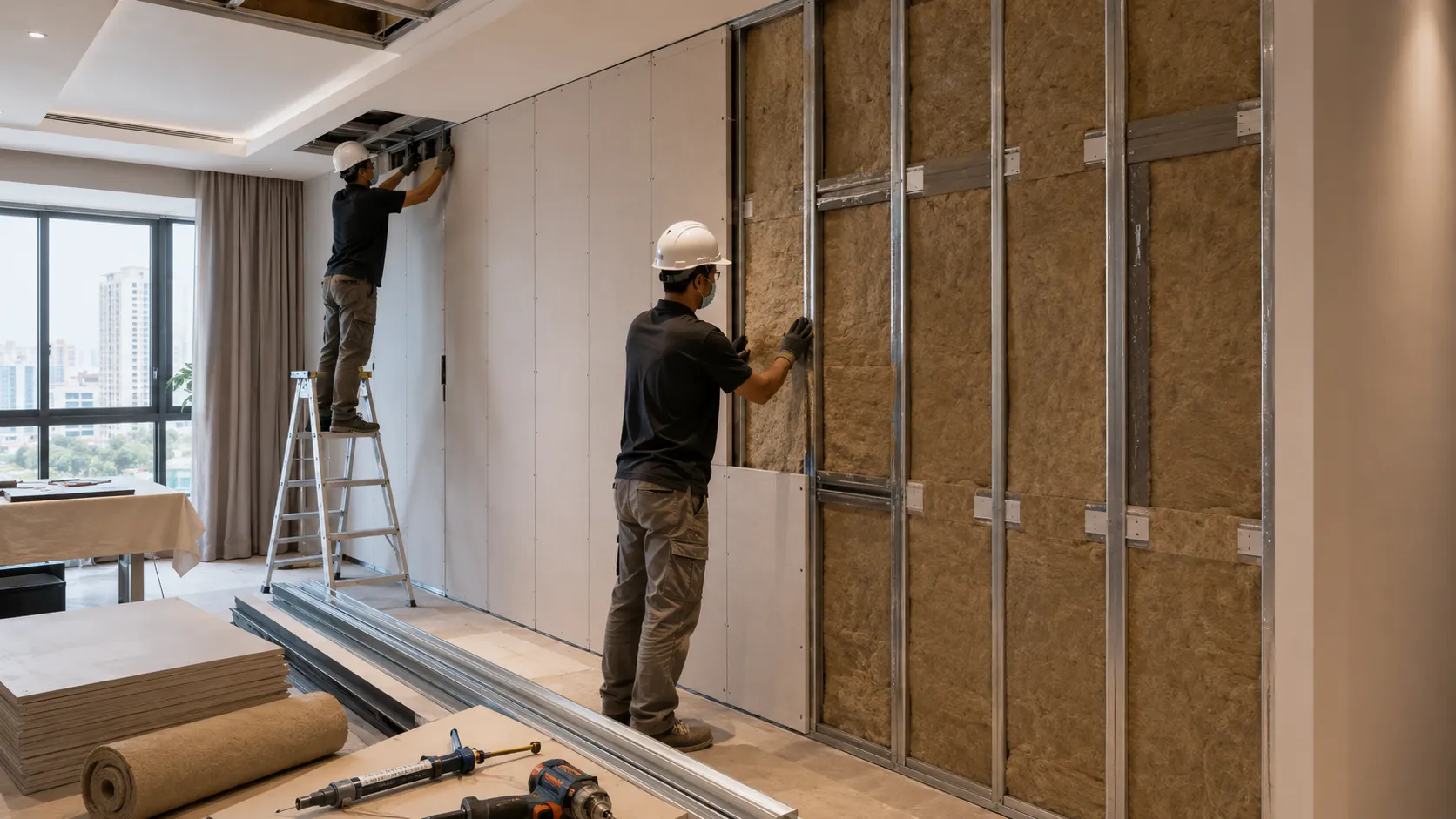
Built up layer by layer, not bolted onto the existing wall
Installing a decoupled wall system means working across the full height and length of the surface - framing, mineral wool insulation and board all go up together, which is why full wall or room treatment typically takes days rather than hours.
What to Check Before You Start a Soundproofing Project
Soundproofing itself isn't a licensed trade the way electrical work is, but it still runs into practical approval questions, particularly in condos and apartments. Any work that involves hacking, building a new stud wall, or altering the ceiling void often falls under the same renovation approval process as other renovation work that affects the building, which means checking with building management or the JMB/MC before starting, not after.
For terrace and semi-D houses, the shared party wall is worth a conversation with your neighbour before work starts, even though there's no formal approval process required in most cases - adding mass to a shared wall is disruptive on both sides during construction, and starting the conversation early tends to go better than a surprise.
Realistic expectations matter too - soundproofing reduces noise, but rarely eliminates it completely. More on what that means for specific situations further down this page.
If your renovation is already going through management approval for other reasons, it's more efficient to include the soundproofing scope in the same submission instead of applying separately.
Soundproofing by Property Type in Kuala Lumpur & Selangor
The likely noise problem, and the treatment that fits it, depends heavily on property type.
Condos and apartments
The most common complaints are impact noise from the unit above and airborne noise through party walls with neighbouring units - both made worse by the concrete-and-tile construction common in Malaysian high-rises, which transmits sound efficiently.
Terrace and semi-D houses
Shared party walls carry sound between terrace units much like a condo wall does, while rooms facing a main road often need window and door treatment more than wall treatment.
Home studios and media rooms
Here, the room's purpose matters more than the type of property - a dedicated studio or theatre room usually needs full treatment whether it sits in a condo or a landed home.
What Affects the Cost?
Beyond the type of treatment, several other factors shape the final price.
Room or wall size
Larger surfaces need more material and labour, though a full-room project often costs less per square foot than treating a single small area due to fixed setup costs.
Noise type
Impact noise treatment is generally more involved and costly than airborne noise treatment, since decoupling systems add complexity that simple mass and sealant don't.
Existing construction
A solid brick or concrete wall needs less added mass than a lightweight drywall partition to reach the same result, which affects both material and labour cost.
Existing finishes
Removing and later replacing skirting, cornices or wall finishes to get proper edge sealing adds cost beyond the acoustic material itself.
Extent of treatment
Treating one wall is a different project from treating an entire room - the number of surfaces involved has a large effect on total cost.
Access and building restrictions
Condos with restricted work hours, lift bookings or narrow corridors for material delivery can add time and cost compared to a landed home with direct access.
Because so many of these factors depend on the actual room and construction, we generally can't give an accurate number without seeing it first. A site visit lets us assess the noise source, construction type and access properly, which is usually the difference between a rough estimate and a quotation you can actually plan around.
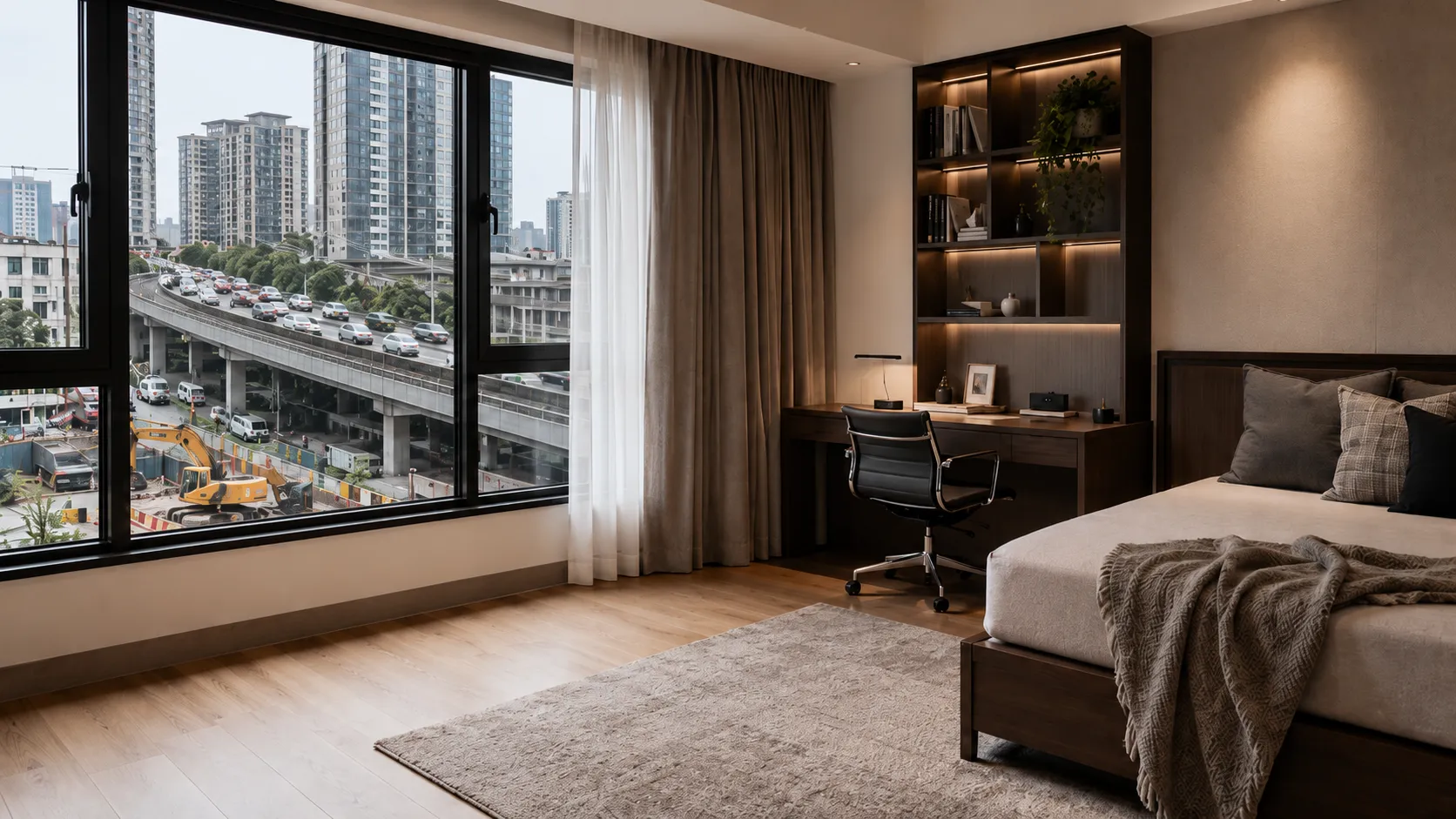
A view like this is a window problem, not a wall problem
When a room faces a busy road or elevated highway, the glass and the gaps around the frame are almost always the weakest point - treating the surrounding wall while leaving the window as-is rarely makes a noticeable difference.
Our Soundproofing Process
Here's what you can expect, from the first site visit to final verification.
Consultation and site visit
Describe the noise problem and share photos if possible. We visit to assess the room, the construction type, and where the noise is actually coming from.
Noise source diagnosis
We confirm whether the issue is airborne or impact noise, and identify the specific surfaces and gaps involved, since this determines the whole treatment approach.
Scope and quotation
A detailed quotation is prepared based on the confirmed treatment - which surfaces, which materials, and what result is realistically achievable.
Preparation
Existing finishes are removed where needed, and the surface is prepared for the acoustic build-up.
Installation
Mass, decoupling and sealant layers are installed in the correct sequence, since skipping or reordering steps undermines the whole system.
Final walkthrough
We review the completed work with you, and where practical, demonstrate the improvement against the original noise problem.
What to Prepare Before a Soundproofing Site Visit
Having a few things ready before we visit makes the assessment faster and the quotation more accurate.
A description of the noise
What it sounds like, when it happens, and how loud it is relative to normal conversation helps us understand whether it's airborne or impact noise before we even arrive.
Photos of the room or wall
Photos of the affected surface, including any existing finishes, help us gauge the construction type and plan the visit.
What's on the other side
If known, whether the other side of the wall or ceiling is a neighbouring unit, a corridor, or outdoor space affects what treatment makes sense.
Rough budget and priorities
Knowing whether you want a complete solution or the most cost-effective option that makes a noticeable difference helps us recommend the right scope.
Common Soundproofing Mistakes to Avoid
Soundproofing has more myths attached to it than most renovation work, which makes it easy to spend money on the wrong fix.
Using foam panels expecting them to block sound
Acoustic foam reduces echo inside a room; it does very little to stop sound passing through a wall. It's frequently confused with actual soundproofing material.
Treating impact noise from only one side
Ceiling treatment alone rarely solves footsteps from upstairs. A realistic plan doesn't promise a fix that isn't achievable from your side alone.
Leaving gaps at the edges
A wall or ceiling treated everywhere except the skirting line, ceiling junction or an electrical socket cutout loses a large share of its effectiveness at that one weak point.
Ignoring the door and window
Treating a wall thoroughly while leaving a hollow-core door or a single-pane window untreated means sound simply takes the easier path.
Skipping decoupling to save cost
Adding mass without any separation from the existing structure helps less than expected, since a rigid connection lets sound and vibration travel through regardless of thickness.
When Soundproofing Won't Fully Solve the Problem
Soundproofing noticeably reduces noise in most situations, but a few scenarios are worth understanding upfront rather than after the work is done.
Impact noise from a source you can't treat
If the noise is footsteps or furniture from the unit above, ceiling treatment helps but rarely solves it completely - the more effective fix sits upstairs, which isn't always something you can arrange.
Very low-frequency noise
Deep bass, heavy machinery or certain traffic noise is the hardest frequency range to block and typically needs more substantial treatment than higher-pitched noise to get a similar improvement.
Partial treatment of a connected space
Treating one wall in a room with an untreated door, window or ceiling limits how much overall improvement is achievable, since sound travels through whichever surface offers the least resistance.
Expecting complete silence
Soundproofing reduces noise, often substantially, but a fully treated room still isn't silent. Setting expectations around meaningful reduction rather than total elimination avoids disappointment.
Three Typical Soundproofing Scenarios
The noisy party wall
A condo owner constantly hears the neighbouring unit's TV and conversations through a shared wall. Adding a decoupled, mass-loaded layer to the party wall brings a noticeable, lasting improvement.
The footsteps from upstairs
An apartment owner is woken by footsteps from the unit above. Ceiling treatment reduces the noise substantially, though the owner is advised upfront that a floating floor installed by the upstairs neighbour would be the more complete fix.
The home studio build-out
A musician converts a spare bedroom into a practice and recording space, with walls, ceiling, floor and door all treated together so late-night sessions don't disturb the rest of the household or the neighbours.
Why Homeowners Work With Us for Soundproofing
Soundproofing is a trade where honest expectations matter as much as the materials used, so we lead with a realistic diagnosis instead of a one-size-fits-all pitch.
Honest diagnosis before a quotation
We tell you upfront whether a full fix is realistic from your side alone. We won't promise results that depend on someone else's unit.
Airborne and impact noise treated differently
Because the two problems need genuinely different solutions, we scope each project around the specific noise type rather than applying the same treatment everywhere.
Clear scope and detailed quotations
You'll know which surfaces, materials and edges are included before work starts, not just a lump-sum number.
Coordinated with the rest of your renovation
Soundproofing is planned alongside hacking, flooring and ceiling work when it's part of a larger renovation, not treated as an afterthought.
For homeowners planning soundproofing as part of a larger project, this pairs naturally with a condo renovation, a plaster ceiling upgrade, or a full interior design and renovation project - it's usually easier to plan acoustic treatment alongside other wall, ceiling and flooring work rather than as a separate job afterward. See our full list of individual renovation services if you're weighing this against other standalone upgrades.
Soundproofing Malaysia FAQs
What's the difference between soundproofing and acoustic treatment?
Soundproofing blocks sound from passing between spaces - through a wall, ceiling or floor. Acoustic treatment improves how a room sounds internally by reducing echo and reverberation. They often get confused because both can involve foam or panels, but a room can be acoustically treated and still let plenty of sound through to the next room, or vice versa.
Will soundproofing my ceiling stop footsteps from the unit above?
It will reduce the noise, often meaningfully, but it's honest to say it rarely eliminates it completely. Impact noise like footsteps travels through the building structure itself, so the most effective fix is a floating floor or underlay installed in the unit above, not just treatment on your ceiling.
How much does soundproofing a room cost in Malaysia?
There's no reliable per-square-foot figure we can quote without seeing the space, because soundproofing cost depends heavily on how the existing wall, ceiling or floor is built, how many surfaces need treating, and what has to be removed and reinstated afterwards. As a rough sense of scale: sealing and upgrading a door is the most affordable item on the list, treating a single wall or ceiling sits well above that, and a fully treated room such as a home studio is a substantially larger project again. We give a firm number after a site visit.
Do acoustic foam panels actually soundproof a room?
Not in the way most people expect. Foam panels reduce echo and improve how a room sounds internally, but they add very little mass, so they do very little to stop sound passing through to the next room. This is one of the most common soundproofing misconceptions.
Can soundproofing be done without breaking or hacking walls?
Often, yes, for wall and ceiling treatment - added mass and decoupled layers can usually be built up from the existing surface rather than requiring the wall to be broken out. Floor treatment is more likely to require removing the existing floor finish first.
Do I need management or JMB approval for soundproofing in a condo?
It depends on the extent of the work. Adding a new wall or ceiling system is often treated like other renovation work that affects the building structure, so check with your JMB or management before starting, particularly if hacking or a new stud wall is involved.
How long does soundproofing usually take?
Sealing a door or window can be done in a day. Treating a single wall or ceiling typically takes a few days to about a week. A fully treated room, such as a home studio, usually takes 2-4 weeks depending on size and how much rebuilding is involved.
Can soundproofing help with traffic or road noise?
Yes, though the window and door are usually the priority over the wall, since glass and gaps are typically the weakest points for outdoor noise. Acoustic glazing or a well-sealed solid-core door often makes a bigger difference than wall treatment alone for this specific problem.
What's the difference between airborne noise and impact noise?
Airborne noise - voices, TV, traffic - travels through the air and is reduced by adding mass and sealing gaps. Impact noise - footsteps, dragged furniture, dropped objects - travels through the physical structure itself and needs decoupling or isolation, not just added mass. Treating one type of noise with a method meant for the other rarely works well.
Will soundproofing my party wall annoy my neighbour?
The work itself involves some noise and disruption during construction, similar to any hacking-adjacent renovation, so it is worth letting your neighbour know beforehand. Once completed, the treatment does not create any noise or disturbance - it only reduces sound transmission.
Is it worth soundproofing a room I'm already renovating for other reasons?
Often yes, particularly for wall, ceiling or floor work, since the surfaces are already open and the marginal cost of adding acoustic treatment is lower than doing it as a separate project later after finishes are already closed up.
Can soundproofing completely eliminate noise?
No, and it is worth being upfront about that. Soundproofing meaningfully reduces sound transmission, sometimes dramatically, but a treated room is quieter, not silent. How much reduction is achievable depends on the noise type, the construction, and how much of the room gets treated.
Can soundproofing work be carried out during normal condo renovation hours?
Usually, yes - soundproofing follows the same permitted working hours as any other renovation trade in the building, which management or the JMB/MC will confirm as part of the approval process. Wall and ceiling work involving hacking or a new stud wall tends to fall under the noisier trades, so it's worth scheduling it within the hours least likely to draw complaints from neighbours.
Do Klang Valley condo management bodies usually require a renovation deposit for this kind of work?
Often, yes, particularly if the work involves hacking, a new stud wall, or altering the ceiling void - many buildings treat this the same as other renovation work that affects the building structure and require a deposit, contractor registration or lift protection before starting. Requirements vary by building, so it's worth checking your specific management rules rather than assuming.
Ready to plan your soundproofing project?
Ready to find out what's possible? Send us a description of the noise problem, a few photos of the room, and your property type. We serve KL, Selangor and the Klang Valley, and we'll recommend the most practical approach.