
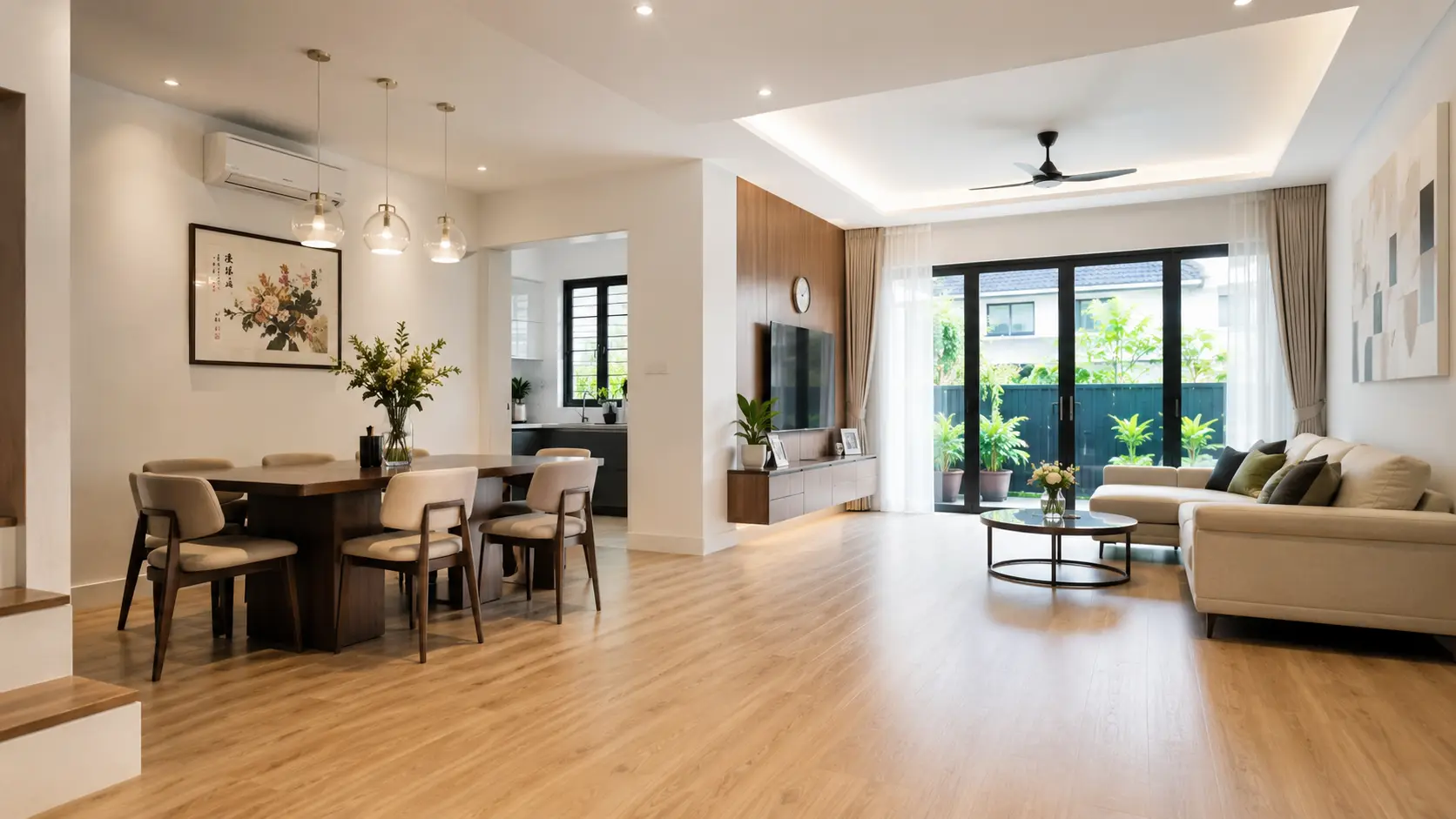
SPC Flooring in Kuala Lumpur & Selangor: Waterproof, Durable and Easy to Install
SPC flooring has become one of the most requested flooring upgrades in Malaysia, mainly because it solves two problems at once - it's genuinely waterproof at the core, and it can often be installed straight over existing tiles without any hacking. My Reno Service installs SPC flooring for condos, apartments and landed homes across KL, Selangor and the wider Klang Valley.
Whether you're replacing worn-out tiles, modernising an older home or renovating an entire unit on a tight schedule, the right SPC flooring depends on the room, the amount of foot traffic and the condition of the floor underneath.
Send us photos of your current floor and roughly what you're trying to achieve, and we'll help you work out whether SPC flooring can go straight over what's there - before you commit to a design.
What Is SPC Flooring?
SPC stands for Stone Plastic Composite - a rigid-core flooring made from limestone powder and PVC, topped with a printed design layer and a clear UV wear layer. Most SPC planks also come with a soft IXPE foam layer already attached underneath for cushioning and sound dampening.
It installs as a floating floor using a click-lock system, similar to laminate, but without laminate's wood-fibre core that swells if it gets wet. The rigid core also makes SPC more resistant to dents from furniture than standard vinyl, while helping to disguise minor imperfections in the subfloor.
The main difference from a full retiling job is what happens underneath. Tiling usually means hacking out the old floor, waterproofing where needed, then laying and grouting new tiles - a process that takes days and creates a lot of dust and debris. SPC flooring can often be clicked together directly over existing tiles, provided they're flat and sound, making it a popular choice for quick, lower-disruption renovations.
Benefits of SPC Flooring
SPC flooring's popularity in Malaysia comes down to a handful of practical advantages over tiles, laminate and standard vinyl - some obvious at a glance, others only appreciated after living with it for a while.
Waterproof core
The stone-plastic core won't swell or warp from water contact the way laminate or timber can, which matters in Malaysia's humidity and during the occasional spill or mopping session.
Can go straight over existing tiles
If the old tiles are flat and sound, SPC can often be clicked together directly on top, avoiding the cost, dust and time of hacking out the existing floor first.
Scratch and dent resistant
The rigid core handles furniture legs, dropped objects and daily foot traffic better than standard vinyl or softer laminate finishes.
Comfortable, warmer underfoot
Compared with ceramic or porcelain tile, SPC feels noticeably warmer and less hard underfoot, thanks to its rigid core and attached foam underlayer.
Sound dampening
The IXPE underlayer absorbs some impact sound, so footsteps and dropped objects generally sound quieter than on bare tile - a small but noticeable difference in condos.
Wide range of looks
SPC comes in wood-look, stone-look and plain finishes across many tones and plank widths, so it's rarely a case of compromising on style to get the practical benefits.
Quick installation
Because it's a floating click-lock floor, a full unit can often be completed in days rather than the week or more that hacking and retiling typically takes.
Easy to clean and maintain
A regular sweep and damp mop is usually enough - there's no grout lines to scrub or natural stone to reseal.
Popular SPC Flooring Looks and Formats
Most SPC flooring requests in Malaysia fall into a handful of look and layout categories. The right one usually depends on the room, the rest of the interior, and how much pattern-matching and cutting the installation involves.
| Look / Format | Best for | Relative cost | Note |
|---|---|---|---|
| Wood-look plank | Most homes, living areas, condos | Economy–Mid-range | Widest range of tones and plank widths |
| Stone / tile-look | Kitchens, modern condo interiors | Mid-range | Reads more contemporary, hides seams well |
| Herringbone / parquet pattern | Feature areas, higher-end living rooms | Premium | More cutting and layout planning required |
| Wide-format long plank | Open-plan living, minimalist interiors | Mid–Premium | Fewer seams, needs a flatter subfloor |
Wood-Look Plank
Best for: most homes, living areas and condos wanting a warm, familiar look without real timber's maintenance.
This is by far the most requested SPC look in Malaysia - printed oak, walnut and other wood-grain finishes across light, mid-tone and dark colourways, usually in standard plank widths that lay quickly with minimal cutting.
It works in almost any room and pairs easily with existing cabinetry and furniture, making it the default choice for many whole-unit renovations.
Stone / Tile-Look
Best for: kitchens and modern condo interiors wanting a concrete or marble look without the weight or cost.
Printed to mimic concrete, marble or terrazzo, this look tends to suit kitchens, dry kitchens and contemporary condo interiors where a cooler, more minimal palette is the goal rather than a warm wood tone.
Because the design is printed rather than naturally formed like real stone, large areas can look more uniform. Some homeowners prefer that cleaner appearance, while others miss the variation of natural marble.
Herringbone / Parquet Pattern
Best for: feature areas and higher-end living rooms where the floor itself is meant to be a design feature.
Shorter planks are laid in a zigzag or basket-weave pattern instead of running in one direction, giving a more architectural, boutique-hotel look that stands out from a standard plank floor.
It takes longer to install and involves more cutting and layout planning than a straight-laid plank floor, so labour cost is generally higher. It tends to work best as a feature in one room or area rather than across an entire unit.
Wide-Format Long Plank
Best for: open-plan living and minimalist interiors wanting fewer visible seams.
Longer, wider planks than the standard format, which reads as more contemporary and reduces the number of seams across a large open-plan living and dining area.
Wider planks show subfloor unevenness more readily than narrower ones, so a flatter, properly levelled subfloor matters more here than with a standard-width plank.
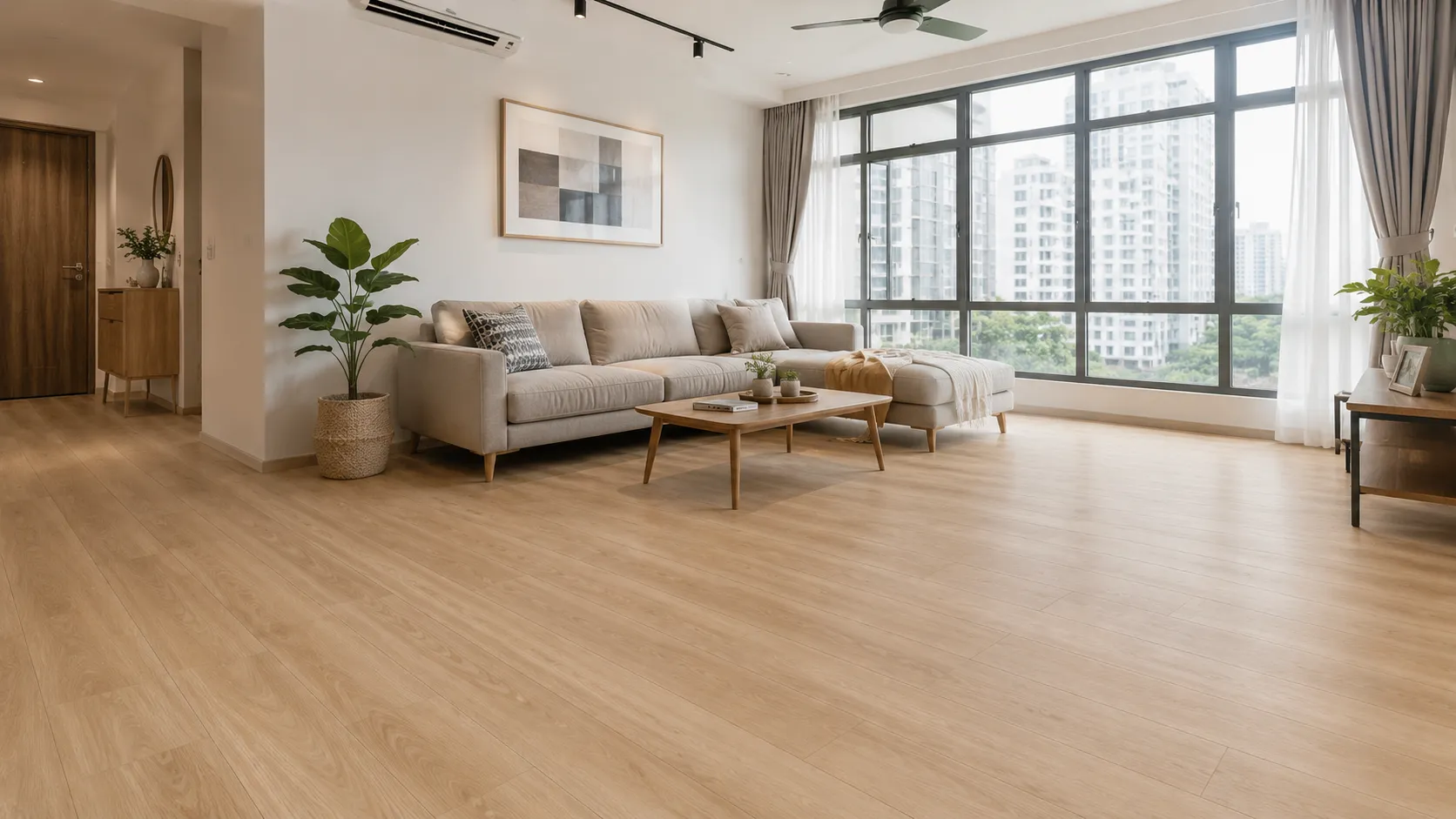
Wood-look or stone-look isn't just a style call
The tone and format you pick affects how forgiving the floor is of an uneven subfloor, how many seams the room ends up with, and how it reads against your existing cabinetry and wall colours - worth comparing samples in the actual room before deciding.
Where Can SPC Flooring Be Installed?
SPC flooring works in most rooms of the home. The main exception is continuously wet areas, where proper waterproofing and tiling still make more sense than a floating floor.
Living and dining rooms
The most common area for SPC flooring, usually chosen for a warm wood-look finish that ties the living and dining space together.
Bedrooms
Softer and warmer underfoot than tile, which matters more in a room people walk across barefoot first thing in the morning.
Kitchens
Thanks to its waterproof core, SPC is well suited to kitchens where occasional spills are expected. Areas with standing water or heavy grease still need extra attention at the edges and transitions.
Hallways
High foot traffic areas benefit from SPC's scratch resistance, and a wood-look finish can visually extend a narrow corridor.
Home offices
A quieter, more comfortable surface for a room where you're often on a chair with castors rolling back and forth all day.
Dry bathrooms and powder rooms
Fine for a dry area or powder room, but continuously wet zones like inside a shower still need proper waterproofing and tiling, not a floating floor.
Condos and apartments
One of the most common flooring choices for condo renovations, mainly because it can often be installed directly on top of the existing tiles - useful given lift booking, noise-hour restrictions and management approval requirements that come with hacking work.
Landed houses
Often used across multiple rooms in one go during a broader renovation, since a consistent floor tone can visually tie a terrace or semi-D's ground floor together.
SPC Flooring vs Laminate vs Ceramic Tile
SPC isn't the only flooring option, and it isn't always the right one. Here's how it generally compares to the two most common alternatives homeowners weigh it against.
| Factor | SPC flooring | Laminate flooring | Ceramic / porcelain tile |
|---|---|---|---|
| Water resistance | Fully waterproof core | Swells and warps if wet | Fully waterproof |
| Comfort underfoot | Warmer, some cushioning | Warmer, some cushioning | Hard and cold underfoot |
| Installation | Floating click-lock, fast | Floating click-lock, fast | Requires hacking, screeding and grouting |
| Maintenance | Sweep and damp mop | Sweep and damp mop, avoid excess water | Grout lines need periodic cleaning or resealing |
| Durability | Dent and scratch resistant | Can dent and show wear faster | Very durable surface, but grout can stain or crack |
| Cost considerations | Mid-range material, low installation cost | Often slightly cheaper material | Higher installation cost due to hacking and labour |
These aren't the only two alternatives, either. If you've decided real ceramic or porcelain tile is worth the extra installation time, see our floor tiles page for material types and costs. If a warm, natural surface matters more than click-lock convenience, our wood flooring page covers solid and engineered timber options. And for a seamless poured floor look instead of visible planks or grout lines, cement screed flooring is worth a look too.
SPC Thickness and Wear Layer: What the Numbers Mean
When comparing SPC flooring, two specifications matter most: the plank's core thickness and the wear layer thickness. They affect different things, so it's worth knowing what each one does before picking a grade.
| Spec | Common range | What it affects |
|---|---|---|
| Plank (core) thickness | 4mm – 6mm+ | Underfoot feel and how well the floor resists flexing over a slightly uneven subfloor - thicker cores feel more solid and hide more imperfections |
| Wear layer thickness | 0.3mm – 0.7mm+ | Scratch and wear resistance at the surface - thinner suits lower-traffic rooms, thicker suits high-traffic areas, pets and rental units |
In practice, economy-grade SPC usually pairs a thinner core with a 0.3mm wear layer, mid-range SPC typically steps up to a 0.3mm–0.5mm wear layer, and premium SPC usually combines a thicker core with a 0.5mm+ wear layer and a longer warranty period.
So, What Does SPC Flooring Actually Cost?
As a rough guide, SPC flooring generally falls into these price ranges per square foot by grade. Treat this as a starting guide - actual pricing depends on the room, the subfloor and the finish covered above.
RM5–RM8 / sq ft
Best for: rentals and budget-conscious whole-unit renovations. Economy-grade SPC with a thinner wear layer, suited to lower-traffic rooms.
RM8–RM12 / sq ft
Most popular: mid-range SPC with a moderate wear layer, and the most common choice for living rooms, bedrooms and full-unit condo renovations.
RM12–RM18 / sq ft
Best for: high-traffic living areas, hallways and homes with pets. Premium SPC with a thicker wear layer and longer warranty.
Indicative KL & Selangor pricing, reviewed 2026. These figures cover material and standard installation only. Not included: subfloor levelling, removing existing flooring, skirting and stair nosing where applicable - final pricing depends on site condition and is confirmed during a site visit.
Factors That Affect SPC Flooring Cost
The grade of SPC is only part of the total cost. The following factors usually have just as much impact on the final quotation.
Total floor area
The larger the area, the more material and labour required, though a whole-unit job often costs less per square foot than a single small room due to fixed setup costs.
Subfloor condition
Uneven, cracked or hollow-sounding existing floors often need levelling compound or repair before SPC can be installed properly, which adds cost.
Wear layer thickness
A thicker wear layer costs more but holds up longer under heavy foot traffic, pet claws and furniture movement.
Pattern and cutting complexity
Herringbone layouts, wide-format planks and rooms with lots of corners or door frames all need more cutting and labour than a simple rectangular room.
Removing old flooring
If the existing floor can't be left in place - because it's too uneven, damaged or already carpet - removal and disposal adds a separate line item.
Skirting and trims
Skirting boards, door threshold strips and stair nosing are usually priced separately from the flooring itself but are needed for a finished look.
Because so many of these factors depend on the actual room and what's underneath the existing floor, we generally can't give an accurate number without seeing it first. A site visit lets us check the subfloor and existing tiles properly, which is usually the difference between a rough estimate and a quotation you can actually plan around.
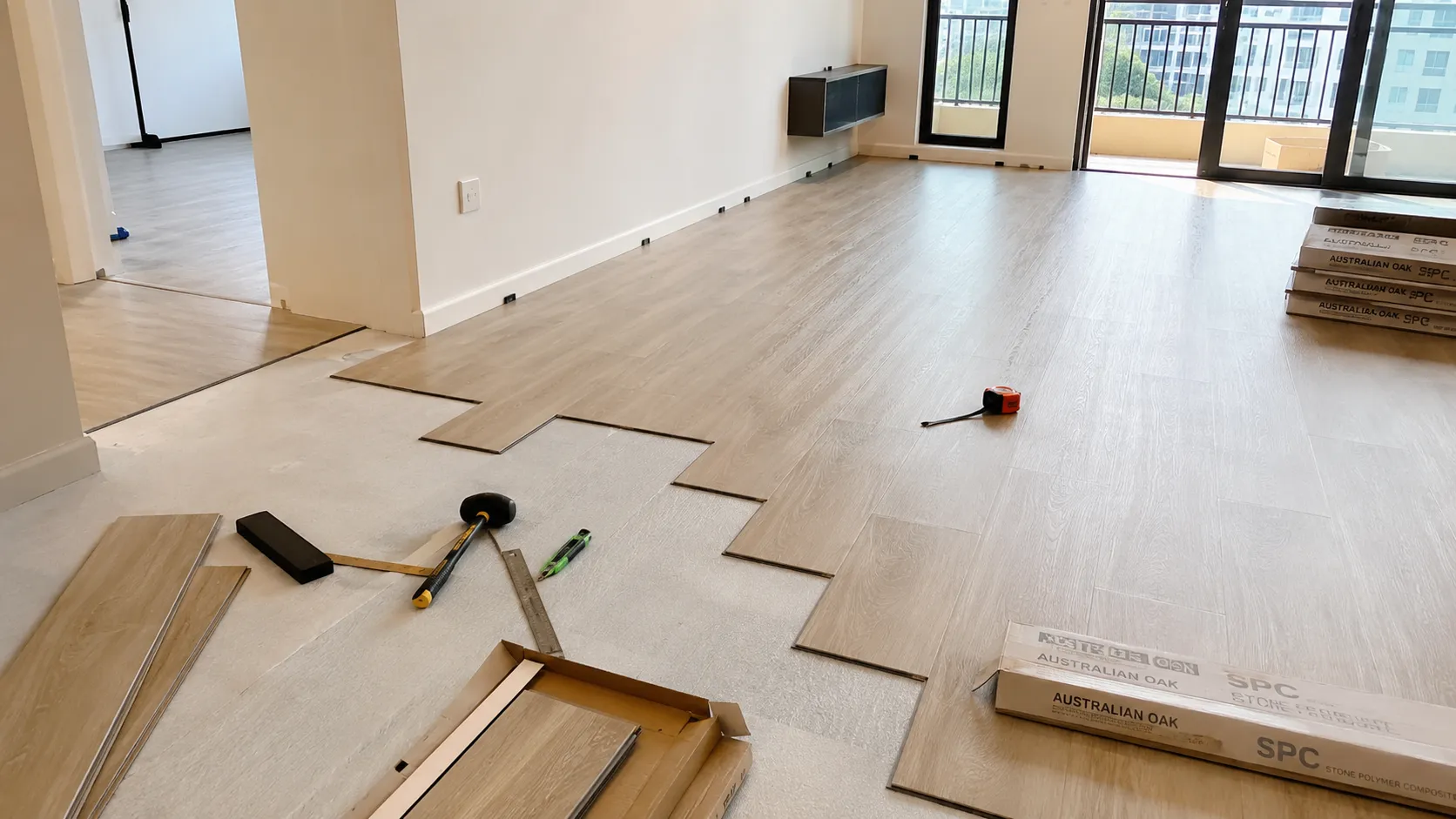
A floating floor, clicked into place plank by plank
No wet trades, no grout, no drying time - planks are measured, cut and locked together directly on the existing floor, which is why an SPC job usually wraps up in days rather than the week or more that hacking and retiling can take.
Our SPC Flooring Installation Process
A clear process, from first message to final inspection, so you know what to expect at each stage before committing to a design.
Initial consultation
Share your room photos, rough floor area and the look you're considering, along with your budget range and timeline.
Site visit
We check the existing floor condition, levelness and whether it's suitable to install directly over, before anything is priced.
Measurements
Exact room dimensions are taken to confirm material quantity, layout direction and where seams and transitions will fall.
Design discussion
Together we'll compare wood-look, stone-look, herringbone and other options to find the right balance between style, practicality and budget.
Quotation
A detailed quotation is prepared based on the confirmed material, any subfloor prep identified during the site visit, and skirting or trim requirements.
Installation
The subfloor is prepared or levelled as needed, underlayment is laid, then planks are clicked into place with proper expansion gaps at the edges.
Finishing
Skirting, transition strips and stair nosing are fitted, and the room is cleaned up before handover.
Final inspection
We walk through the finished floor with you, checking seams, transitions and overall finish before considering the job complete.
Common SPC Flooring Mistakes to Avoid
SPC flooring is fairly forgiving compared to tiling, but a few recurring mistakes still cause the most regret afterward.
Choosing price over wear layer
A very thin wear layer may look fine on day one but scratches and dulls faster in high-traffic areas, which ends up costing more if the floor needs replacing sooner.
Skipping subfloor levelling
Installing over an uneven or hollow-sounding floor can cause clicking noises, visible dips, or premature wear at the high and low points.
Forgetting the expansion gap
SPC needs a small gap around the room's edges to expand and contract with temperature changes. Skipping it can cause the floor to buckle or peak at the seams over time.
Treating it as suitable for continuously wet areas
A waterproof core doesn't mean the whole floor system is sealed like a tanked wet area. Installing it inside a shower or a spot that stays wet invites problems at the seams over time.
Hiring an inexperienced installer
Uneven seams, gaps at transitions and a hollow, echoey sound underfoot are usually workmanship issues - one of the areas where a lack of experience shows up quickly once the floor is walked on.
When We Wouldn't Recommend SPC Flooring
SPC is a strong fit for most rooms, but it isn't the right answer for everything. These are the situations where we'd usually steer a homeowner toward a different material instead.
Continuously wet areas
Inside a shower or anywhere that stays wet, proper tanking and tiling still holds up better than a floating floor over the long run.
Severely uneven or damaged subfloors
If the existing floor needs extensive structural repair rather than simple levelling, it's often more cost-effective to address that properly first, or reconsider the finish altogether.
Rooms with intense, sustained direct sun
Prolonged direct sunlight can cause any printed floor covering to fade or expand unevenly over time - a spot better suited to tile, or one that needs curtains or UV film on the glazing regardless of flooring choice.
Wanting the authentic feel of real stone or timber
SPC's printed finishes look convincing, but if genuine natural stone or solid timber's look, feel and long-term character is the priority, SPC is a compromise rather than a substitute.
Three Common SPC Flooring Scenarios
The quick condo refresh
A landlord wants to refresh a rental condo before new tenants move in. Rather than hack up the dated, stained tiles, mid-range wood-look SPC is installed directly over them in just a few days.
The whole-unit renovation
A family renovating their landed home is tired of the ground floor's mismatched parquet and cracked tiles. One consistent wood-look SPC floor goes down across the living, dining and hallway areas, tying the whole space together.
The feature herringbone living room
A homeowner wants the living room to feel a little more special than the rest of the unit. Standard plank SPC covers the other rooms, while the living room gets upgraded to a herringbone pattern as a deliberate design feature.
Why Homeowners Work With Us for SPC Flooring
Installing SPC flooring looks straightforward, but getting it right depends on careful subfloor preparation, proper expansion gaps and neat finishing details.
Clear scope and detailed quotations
You'll know what material, subfloor prep and finishing is included before work starts, not just a lump-sum number.
Honest advice on what your floor can take
We tell you upfront if your existing floor isn't suitable to install over directly, rather than finding out partway through the job.
Careful installation
Subfloor levelling, expansion gaps and seam alignment are done properly, since these are what separate a floor that lasts from one that doesn't.
A transparent process
From the first site visit through to final inspection, you'll know what's happening at each stage rather than waiting for a surprise at the end.
For homeowners planning flooring as part of a larger project, this pairs naturally with a full home renovation, a condo renovation, or updates to a living room design - flooring is usually easiest to plan alongside skirting, paint and lighting rather than as a standalone job. If you're weighing this against other standalone upgrades, see our full list of individual renovation services.
SPC Flooring Malaysia FAQs
What is SPC flooring made of?
SPC stands for Stone Plastic Composite. It's built from a rigid core of limestone powder and PVC, topped with a printed design layer and a clear UV wear layer, usually with a soft IXPE underlayer attached to the bottom for cushioning and sound dampening. The rigid core is what makes it dent-resistant and dimensionally stable compared to standard vinyl.
Is SPC flooring really waterproof?
The core itself is fully waterproof and won't swell or warp from water contact, which is a real advantage over laminate or timber. That said, water can still seep into the seams between planks and under skirting over time, so it isn't the same as a tanked wet area - most manufacturers still don't recommend it inside a shower or an area that stays continuously wet.
Can SPC flooring be installed over existing tiles?
Often, yes, as long as the existing tiles are structurally sound, reasonably flat and free of hollow or loose sections. This is one of the main reasons homeowners choose SPC flooring - it can avoid the cost, mess and time of hacking out old tiles first. An uneven or damaged tile floor still needs to be levelled or repaired before installation.
What's the difference between SPC flooring and laminate flooring?
The main difference is the core material. Laminate uses a compressed wood-fibre (HDF) core, which can swell or warp if it gets wet. SPC uses a stone-plastic composite core, which is fully waterproof. SPC also tends to feel more solid underfoot and is generally more dent-resistant, though good laminate can look very similar and is sometimes slightly cheaper.
What's the difference between SPC flooring and vinyl flooring?
SPC is technically a type of rigid vinyl flooring, so the comparison is usually against standard vinyl sheet or vinyl tile without the rigid core. Standard vinyl is thinner, more flexible and cheaper, but it shows subfloor imperfections more easily and dents more readily under furniture. SPC's rigid core hides minor subfloor unevenness better and holds up longer under daily wear. See our vinyl flooring page for the full comparison.
Is SPC flooring suitable for condos and apartments?
Yes, it's one of the most common flooring choices for condo and apartment renovations in Malaysia, partly because it can often go straight over existing tiles without hacking, which matters in buildings with strict renovation timelines, lift booking and noise-hour restrictions.
Can SPC flooring be used in the kitchen or bathroom?
Kitchens are generally fine, since SPC handles occasional spills and splashes well. Bathrooms are more case-by-case - it can work in a dry area or powder room, but continuously wet zones like inside a shower still call for proper waterproofing and tiling rather than SPC flooring.
How long does SPC flooring last?
Most SPC flooring is rated for 10 to 20+ years of residential use, depending on the thickness of the wear layer and how well the subfloor was prepared before installation. A thicker wear layer generally holds up better in high-traffic areas like living rooms and hallways.
Does SPC flooring need skirting or trim?
SPC is a floating floor, so it needs a small expansion gap around the room's edges, which skirting or a trim strip usually covers. Skipping skirting can leave a visible gap and also removes the buffer that lets the floor expand and contract slightly with temperature changes.
How much does SPC flooring cost in Malaysia?
As a rough guide, economy-grade SPC with a thin wear layer runs around RM5–RM8 per sq ft, mid-range SPC around RM8–RM12 per sq ft, and premium SPC with a thicker wear layer and longer warranty around RM12–RM18 per sq ft. These figures are for material and standard installation only - subfloor levelling, skirting and removing old flooring are usually quoted separately.
Can SPC flooring be installed by homeowners themselves (DIY)?
It's designed as a click-lock floating floor, so it's more DIY-friendly than tiling or timber. That said, getting the subfloor properly level, cutting planks cleanly around corners and door frames, and leaving the correct expansion gaps all affect how the finished floor looks and performs, so many homeowners still prefer a professional installer for a full-unit job.
Is SPC flooring noisy to walk on?
Less than you might expect for a floating floor, mainly because of the IXPE underlayer most SPC products include, which absorbs some impact sound. It's still not perfectly silent, and a hollow, echoey sound usually means the subfloor wasn't levelled properly or the underlayment was skipped.
Ready to plan your SPC flooring?
Send us a few photos of the room, your rough floor area and your budget range. We'll help you understand what's realistic - including whether it can be installed directly over your existing floor - before you commit to a design.