
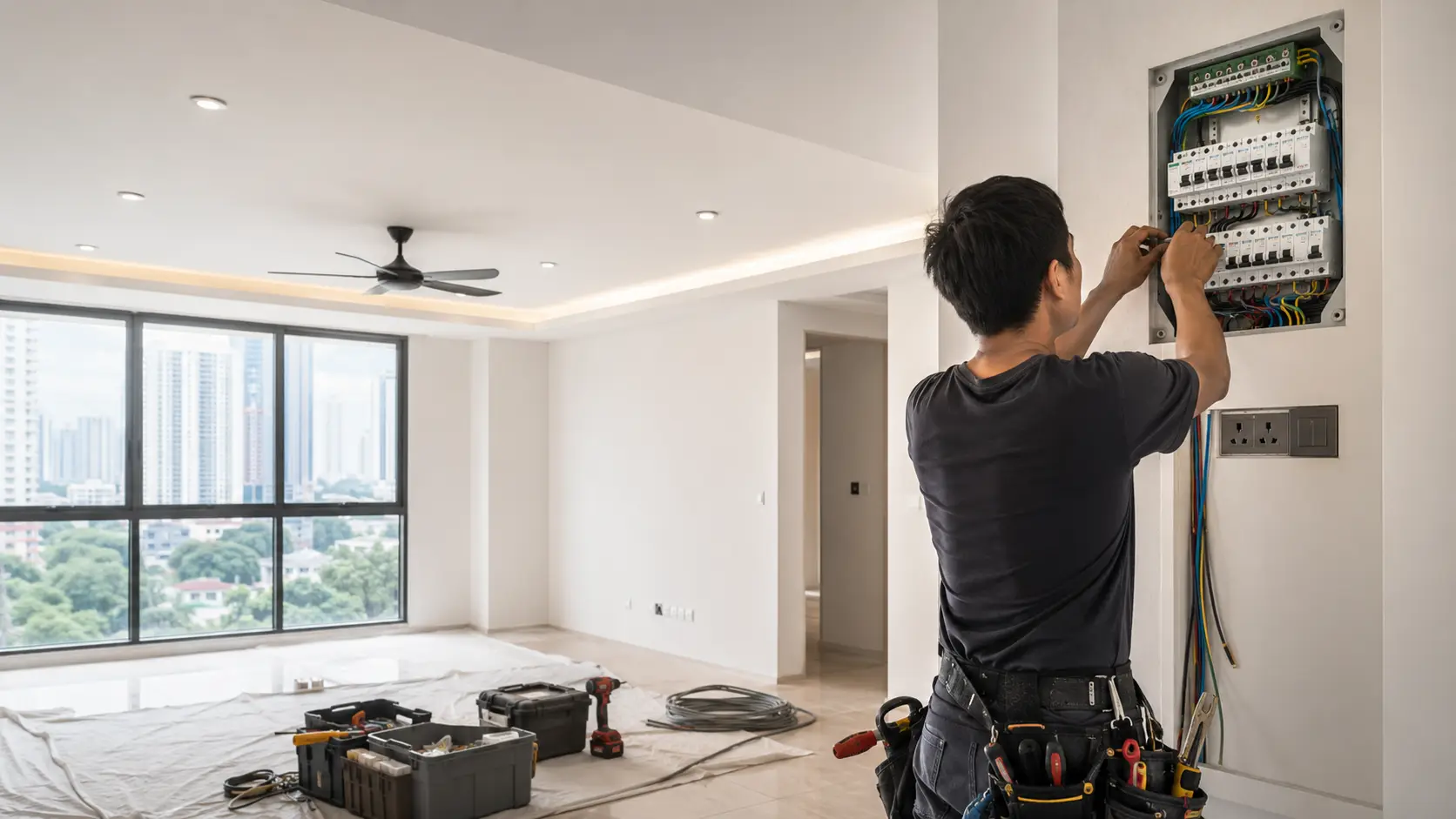
Electrical Services in Malaysia: Rewiring, Panel Upgrades and Contractor-Led Safety Work
Electrical work covers everything from a single extra power point to a full rewire of an older home - and unlike most renovation trades, it's one of the few areas where using an unregistered installer isn't just a quality risk but a safety and legal one. My Reno Service carries out electrical services for homes, apartments and condos across KL, Selangor and the wider Klang Valley, from small additions during a renovation to full panel and wiring upgrades.
Whether you're dealing with a fuse box that trips constantly, an older home with wiring that's never been touched since it was built, or simply need more power points and lighting circuits for a renovation, the right scope depends on the age of the existing wiring, the condition of the distribution board, and what the space is actually going to be used for.
Send us photos of your existing distribution board or wiring and tell us what's not working - frequent tripping, not enough points, or a full rewire - and we'll help you understand what's realistic before committing to a scope.
What Do Electrical Services Actually Cover?
Electrical services covers any work involving a property's wiring, distribution board, power points, switches and lighting circuits - from adding a single socket to rewiring an entire unit. In Malaysia, this work sits under the Electricity Supply Act 1990 and is regulated by Suruhanjaya Tenaga (the Energy Commission), which means wiring work legally needs to be carried out by a competent, registered electrical contractor, not just any general contractor.
Most requests fall into a few categories: adding power points or lighting circuits during a renovation, upgrading an old fuse box or distribution board that keeps tripping, rewiring a property where the cabling has never been replaced since it was built, or bringing a bathroom or kitchen up to current safety standards with proper earth leakage protection.
Electrical work is one of those things that's inexpensive to get right during a renovation, but surprisingly costly to change afterwards. Once the walls, ceilings and flooring are finished, even adding a single missed power point can mean cutting everything open again. That's why it's worth planning the electrical layout early, alongside hacking and plumbing, rather than as an afterthought once the design is finalised.
Our 2026 KL & Selangor contractor pricing study found median prices from RM115 for a lighting point to RM245 for an air-cond point in a fixed 21-point scope.
Which Electrical Upgrade Do You Need?
If you already know what's bothering you about your electrical setup, here's roughly where to start before reading the full breakdown below.
Fuse box keeps tripping
This points to an overloaded or outdated distribution board. A DB upgrade with correctly sized circuit breakers is typically the fix, not just resetting the trip switch each time.
Not enough power points
Common in older homes built before modern appliance loads. Additional circuits and points can usually be added without a full rewire, depending on the existing wiring condition.
Old or unknown wiring history
If the wiring has never been replaced and the property is more than 20-25 years old, a full rewire is usually worth considering, especially before other renovation work closes up the walls.
No earth leakage protection
Bathrooms and outdoor points without RCCB/ELCB protection are a real shock risk. This is a common safety gap in older Malaysian homes.
Benefits of Getting Electrical Work Done Properly
Electrical work rarely gets homeowners excited - it's barely visible once finished. But getting it right affects safety and daily life in the property well beyond the day the work is completed.
Reduced fire and shock risk
Outdated wiring, overloaded circuits and missing earth leakage protection are common causes of house fires and electric shock incidents - addressing them removes a real, ongoing risk instead of a cosmetic one.
Enough capacity for modern appliances
Aircon units, induction hobs, water heaters and EV chargers all draw significant load. Older wiring and panels sized for a much smaller appliance mix often can't handle today's usage without nuisance tripping.
Fewer nuisance trips
A distribution board with correctly sized and distributed circuits means one overloaded socket doesn't cut power to half the house.
Better lighting design
Planning lighting circuits properly allows for layered lighting - ambient, task and accent - instead of a single ceiling point per room.
Compliance for sale or rental
Buyers, tenants and property agents increasingly ask about the condition of wiring and the distribution board, particularly for older units. Documented, compliant electrical work is a point in your favour.
Future-proofing for smart home and EV
Running additional circuits or conduit during a renovation, even if not immediately wired up, makes it much easier to add smart switches, extra points or an EV charger later without cutting into finished walls.
Electrical Services We Handle
Electrical work covers a wide range of scope, from a single afternoon job to a multi-week full rewire. Most projects fall into one of these categories.
| Service | Best for | Relative cost | Note |
|---|---|---|---|
| Additional power points | Adding sockets during renovation or after | Budget (RM80–RM150 / point) | Cost depends on wiring run length and wall type |
| Lighting circuit & point installation | New lighting layouts, feature lighting | Budget–Mid (RM100–RM250 / point) | Higher for false ceiling or concealed wiring |
| DB / consumer unit upgrade | Frequent tripping, outdated fuse box | Mid-range (RM800–RM2,500) | Cost depends on number of circuits and board capacity |
| Partial rewiring | Specific problem areas, older sections of wiring | Mid-range (RM3,000–RM8,000) | Scope varies significantly by area and access |
| Full rewiring | Homes over 20-25 years old, unknown wiring history | Major (RM8,000–RM20,000+) | Best planned alongside hacking and ceiling work |
| RCCB / earth leakage installation | Bathrooms, outdoor points, safety compliance | Budget–Mid (RM300–RM800 / circuit) | Often bundled into bathroom renovation projects |
| High-load circuit (aircon, EV charger) | Dedicated circuits for major appliances | Mid-range (RM500–RM1,800 / circuit) | Cost depends on cable run and spare DB capacity |
Indicative KL & Selangor pricing, reviewed 2026. These figures cover material and labour for standard access conditions. They exclude wall or ceiling opening and patching for concealed wiring, and any Suruhanjaya Tenaga or TNB related fees - final pricing depends on site condition and is confirmed during a site visit.
What Each Service Actually Involves
A quick breakdown of what's actually involved in each type of electrical work, and who it tends to suit.
Additional Power Points & Circuits
Best for: homeowners who find themselves relying on extension cords and multi-plug adapters because there simply aren't enough sockets in the right places.
Adding power points is a frequent electrical request, whether it's a socket for a new kitchen appliance, a point behind a TV console, or extra sockets in a bedroom that was built with only one. Where the run is short and the wall is accessible, this can often be done without major disruption.
The main cost driver isn't the socket itself but how far the wiring has to travel back to the distribution board, and whether it needs to be chased into a wall, run through a ceiling void, or surface-mounted in trunking. Concealed wiring gives the neatest finish, although it takes more work and time because the cables need to be hidden inside walls or ceilings.
Lighting Circuit & Point Installation
Best for: renovations planning a proper lighting layout - ambient, task and accent lighting - rather than a single central ceiling point.
Lighting circuits are typically planned alongside a false ceiling or plaster ceiling design, since concealed wiring, recessed downlights and cove lighting all need to be roughed in before the ceiling is closed up.
Downlight positions decided after the ceiling is finished usually mean surface-mounted conduit or reopening the ceiling work - one of the clearest reasons to plan lighting early.
DB / Consumer Unit Upgrade
Best for: homes with an outdated fuse box, frequent circuit trips, or a distribution board that's clearly undersized for the current appliance load.
Think of the distribution board (DB) as the control centre of your home's electrical system - it houses the circuit breakers that protect each circuit in the property. Older homes often have a DB sized for far fewer appliances than a modern household actually runs, which shows up as breakers tripping whenever too many things run at once.
Upgrading the DB usually means installing a board with more circuit ways, correctly rated breakers for each circuit, and RCCB/ELCB protection where it's missing. This is frequently paired with a partial rewire if the existing circuit wiring itself is also undersized.
Full and Partial Rewiring
Best for: older properties where the wiring has never been replaced, or specific areas with a known history of problems.
Rewiring doesn't just mean replacing a few sockets. It means replacing the cables hidden inside the walls that connect your distribution board to every switch, light and power point.
It's the most involved electrical service, and usually the most disruptive, since it typically means opening walls or ceilings to access the old wiring.
A full rewire generally makes sense for properties over 20-25 years old where the wiring history is unknown, particularly ahead of other renovation work that will already be opening up walls and ceilings.
A partial rewire, limited to specific problem circuits or areas, is often a more practical option when the rest of the wiring is in reasonable condition.
Safety Compliance & Earth Leakage Protection
Best for: bathrooms, outdoor points and older homes without residual current protection.
An RCCB (residual current circuit breaker), sometimes called an ELCB, cuts power automatically if it detects current leaking to earth - the kind of fault that causes electric shocks. It's now standard practice for wet areas and outdoor points, but many older Malaysian homes were built before this became common.
Adding this protection is a relatively affordable upgrade considering the safety benefit it provides, and it's frequently bundled into a bathroom renovation instead of being scheduled as a stand-alone job.
High-Load Circuits for Aircon, EV Charging and Major Appliances
Best for: homeowners adding a new aircon unit, induction hob, instant water heater or EV charger.
Adding another air conditioner often seems straightforward, until the existing circuit starts tripping because it's carrying more load than it was designed for. Major appliances draw far more current than a standard socket circuit, and in worse cases, sharing a circuit can lead to overheated wiring. The safer solution is a dedicated circuit sized for that specific appliance.
EV charger installation in particular depends heavily on how much spare capacity the existing DB has - in some older landed homes and most apartment car park setups, this needs to be assessed carefully, sometimes alongside the building management or utility provider, before a charger point can be added.
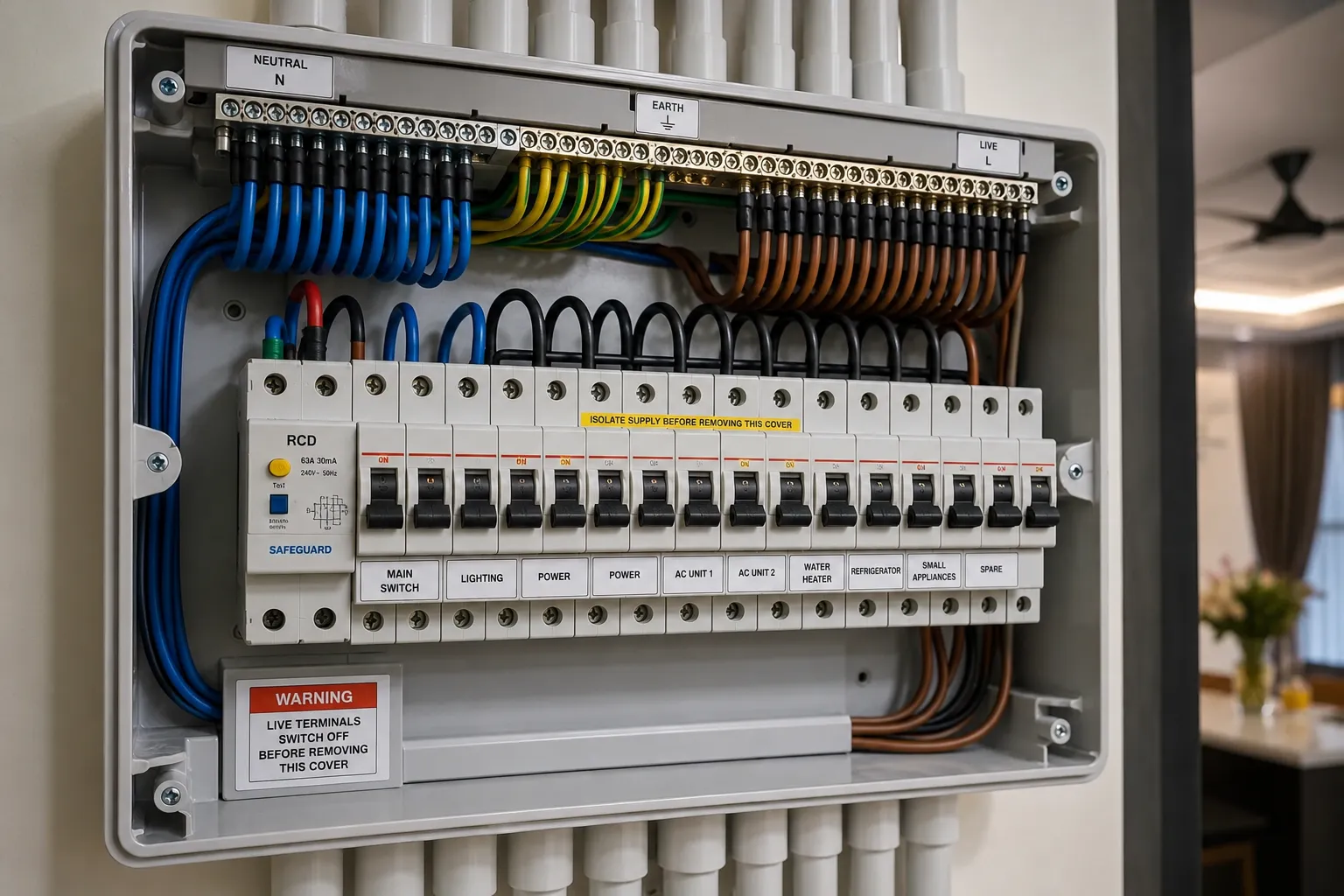
Every circuit labelled, every connection accounted for
A board like this makes fault-finding much easier - lighting, power, each aircon unit, the water heater and the fridge all sitting on their own labelled circuit, with an RCD covering the board. That's the standard we work to on every DB upgrade, not just what's visible once the cover goes back on.
Why Electrical Work Needs a Registered Electrical Contractor
Electrical installation work in Malaysia is regulated under the Electricity Supply Act 1990, overseen by Suruhanjaya Tenaga (the Energy Commission). This means wiring, distribution board and circuit work legally needs to be carried out by a competent person and a registered electrical contractor - it isn't a task a general handyman or an unlicensed contractor is permitted to carry out, regardless of how straightforward the job looks.
This matters beyond compliance. Electrical faults are a genuine fire and shock risk, and mistakes aren't always visible - a poorly terminated connection or an undersized cable can work fine for months before failing. Using a properly registered electrical contractor is the main safeguard against that kind of hidden risk.
For renovation projects, electrical work is planned and coordinated as part of the overall project scope rather than handled as a separate, disconnected trade.
If you're getting quotes for electrical work specifically, rather than as part of a larger renovation, it's reasonable to ask any contractor about their registration and how the work will be certified - this isn't an unusual question, and a contractor confident in their compliance shouldn't hesitate to answer it.
Electrical Services by Property Type
Property type and age largely determine how much electrical work is likely needed.
Landed homes
Terrace, semi-D and bungalow homes have more flexibility for a full rewire or DB relocation since walls and roof space are more accessible, but older terrace and semi-D houses built before the 2000s are also the most likely to still be running original wiring.
Condos and apartments
Electrical work in condos is usually more contained - within-unit rewiring and point additions are common, but anything affecting shared risers, the building's main supply, or EV charger points in car parks generally needs management or JMB coordination on top of the contractor work itself.
Older vs newer builds
Properties over 20-25 years old are far more likely to need a full rewire or DB upgrade, while newer builds more often just need additional points or lighting circuits added during a renovation rather than a safety-driven upgrade.
Factors That Affect Electrical Services Cost
Beyond the type of service you need, several other factors shape the final price - some obvious, some only clear once work starts.
Wiring accessibility
Concealed wiring chased into walls or run through ceiling voids costs more and takes longer than surface-mounted trunking, but gives a cleaner finished look.
DB capacity and condition
A distribution board with no spare circuit ways left may need a full board replacement rather than a simple breaker swap, which adds cost.
Number of points and circuits
Each additional point or dedicated circuit adds its own wiring run, labour and, where relevant, wall or ceiling opening and patching.
Age and condition of existing wiring
Old, unlabelled or already-damaged wiring often needs to be traced and partially replaced before new work can be added safely, which adds time.
Wall and ceiling type
Brick or block walls take longer to chase than drywall, and reinforced concrete slabs are harder to core through than a suspended ceiling void.
Coordination with other trades
Electrical work sequenced the right way alongside hacking, plastering and ceiling work is generally more efficient than scheduling it as a stand-alone visit.
Because so many of these factors depend on the actual property, we generally can't give an accurate number without seeing it first. A site visit lets us check the existing wiring, DB condition and access properly, which is usually the difference between a rough estimate and a quotation you can actually plan around.
Our Electrical Services Process
Here's what you can expect during the process, from the first site visit to final testing.
Consultation and site visit
Share photos of your distribution board and the issue you're trying to fix, along with your budget and timeline. We then visit to assess the existing wiring condition, DB capacity and access.
Load and circuit assessment
We assess how much electricity your appliances draw, existing circuit distribution, and identify any safety gaps such as missing earth leakage protection.
Scope and quotation
A detailed quotation is prepared based on confirmed points and circuits, DB work, and any wall or ceiling opening needed.
Installation
Wiring, DB work, points and circuits are installed, coordinated with hacking, ceiling and plastering trades if part of a larger renovation.
Testing and certification
Circuits are tested and RCCB/ELCB function is verified before we consider the work complete.
Final walkthrough
We review the completed points, switches and DB labelling with you before sign-off.
What to Prepare Before an Electrical Site Visit
Having a few things ready before we visit makes the assessment faster and the quotation more accurate.
Photos of your DB
A clear photo of the existing distribution board, including the label if visible, helps us gauge its age and capacity before we arrive.
What's actually not working
Frequent tripping, not enough points, no earth leakage protection - a specific list helps us prioritise what to check first.
Any major appliances planned
An EV charger, induction hob or extra aircon units affect DB capacity and circuit planning, so it helps to know about these upfront rather than partway through.
Rough budget and timeline
Especially if electrical work is part of a larger renovation, knowing the overall timeline helps us sequence it with other trades correctly.
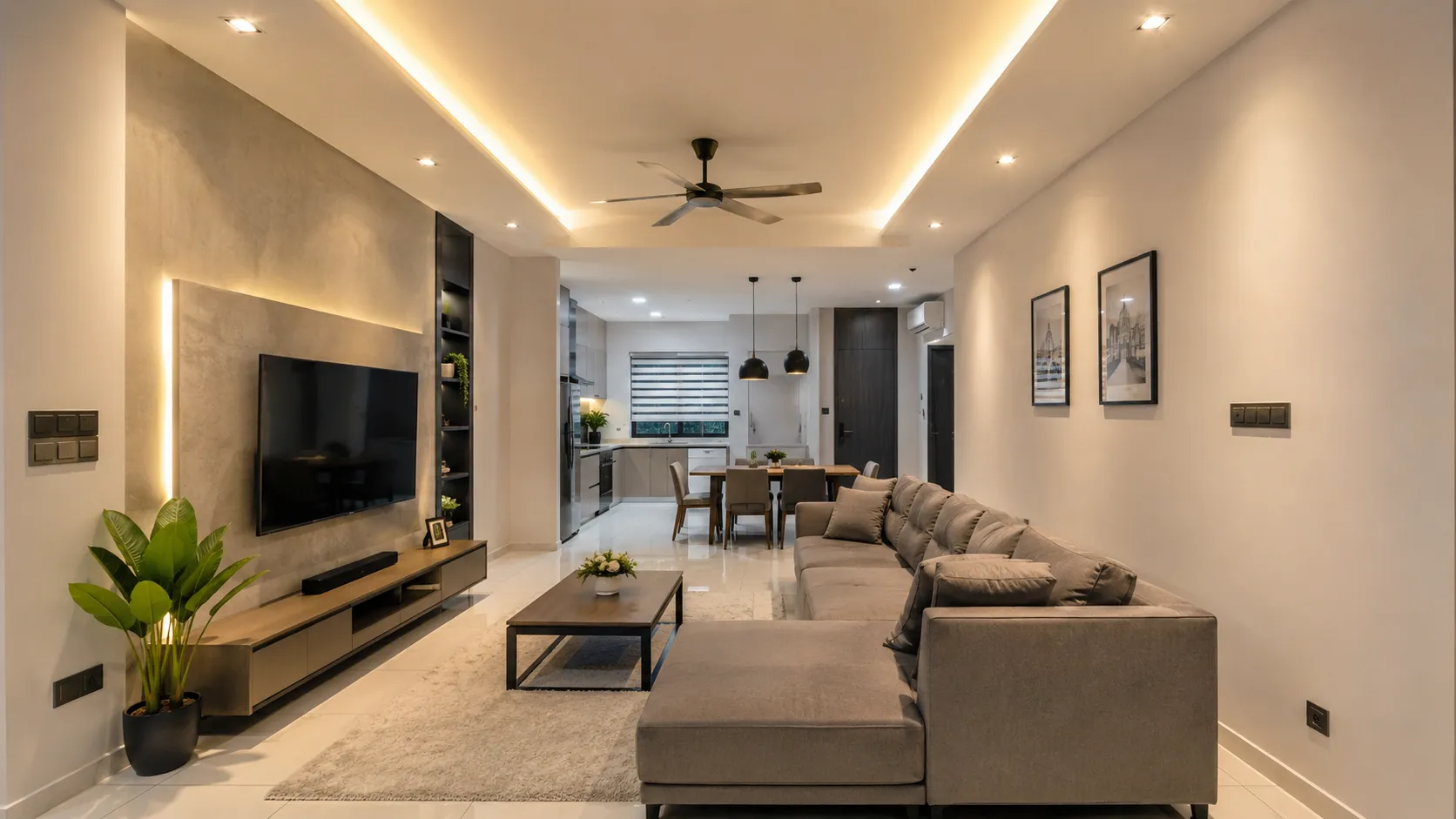
Layered lighting changes how a room feels at night
Cove lighting along the ceiling perimeter, recessed downlights and a statement pendant over the dining table each need their own wiring run planned before the ceiling closes up - this is what a properly planned lighting circuit makes possible, rather than a single central ceiling point.
Common Electrical Work Mistakes to Avoid
Electrical mistakes aren't always obvious right away, which makes them easy to overlook until they cause a real problem. These are the ones that cause the most regret.
Hiring unregistered or unlicensed installers
Unregistered work carries real safety risk and no formal accountability if something fails later - this is one trade where the cheapest quote can genuinely cost more.
Undersizing the distribution board
Upgrading only for current needs without accounting for appliances you might add later, like an EV charger or additional aircon units, often leads to a repeat upgrade sooner than expected.
Leaving wet areas without RCCB protection
A bathroom or outdoor point without earth leakage protection carries a genuine safety risk that's easy to fix but easy to overlook if no one raises it.
Finalising finishes before confirming electrical layout
If power point and lighting positions aren't confirmed before walls and ceilings close up, fixing it later almost always means visible conduit or cutting into finished work.
Overloading a single circuit with major appliances
Aircon, water heater and kitchen appliances sharing one general-purpose circuit is a common cause of tripping and, over time, overheated wiring.
Three Typical Electrical Services Scenarios
The tripping fuse box
An older terrace house's DB trips every time the aircon and washing machine run together. A DB upgrade with properly sized circuits and a dedicated aircon circuit stops the nuisance tripping.
The pre-renovation rewire
A 25-year-old apartment being fully renovated gets a complete rewire alongside the hacking and ceiling works, since the walls are already open - avoiding the cost of doing it separately later.
The bathroom safety upgrade
A homeowner adds RCCB protection to a bathroom during a small renovation after noticing there was none on the existing circuit, fixing a safety issue that had existed since the unit was built.
Why Homeowners Work With Us for Electrical Services
Electrical work is one trade where cutting corners doesn't show up right away - which is exactly why we treat it as a properly scoped part of the project, not an informal add-on.
Integrated project planning
Electrical work is planned alongside the renovation scope, so wiring, lighting, ceilings, cabinetry and finishes can be coordinated before work begins.
Coordinated with the rest of the renovation
Electrical layout is planned alongside hacking, plastering and ceiling work, so wiring gets roughed in at the right stage - not after everything else is already finished.
Clear scope and detailed quotations
You'll know what points, circuits and DB work are included before work starts, not just a lump-sum number.
Straightforward guidance on compliance
We explain what's a safety requirement, like RCCB protection, versus what's optional, so you can prioritise your budget accordingly.
For homeowners planning electrical work as part of a larger project, this pairs naturally with a kitchen renovation, a bathroom renovation, a plaster ceiling project, soundproofing, or a feature wall with integrated lighting - it's usually easier to plan wiring, lighting and acoustic treatment together with the rest of the renovation scope rather than as a separate job afterward. See our full list of individual renovation services if you're weighing this against other standalone upgrades.
Electrical Services Malaysia FAQs
Do I need a licensed electrical contractor for electrical work in Malaysia?
Yes. Electrical installation work is regulated under the Electricity Supply Act 1990 by Suruhanjaya Tenaga (the Energy Commission), and wiring, distribution board and circuit work legally needs to be carried out by a competent person and a registered electrical contractor - not a general handyman, regardless of how small the job looks.
How do I know if my home needs rewiring?
Signs include frequent circuit trips, warm or discoloured switch plates, a burning smell near sockets, visible cracked or brittle wire insulation, or simply not knowing when the wiring was last replaced in a property over 20-25 years old. If in doubt, a site assessment can confirm whether a full or partial rewire makes sense.
How much does electrical rewiring cost in Malaysia?
As a rough guide, partial rewiring for specific problem areas typically runs RM3,000-RM8,000, while a full rewire for a landed home or apartment is usually RM8,000-RM20,000+ depending on size and access. These figures cover material and labour only - wall and ceiling opening and patching are usually priced separately.
What is an RCCB and do I need one?
An RCCB (residual current circuit breaker), sometimes called an ELCB, automatically cuts power if it detects current leaking to earth - the kind of fault that causes electric shocks. It's considered standard protection for bathrooms and outdoor points today, though many older Malaysian homes were built without it.
Can electrical work be done without opening walls or ceilings?
Sometimes. Surface-mounted wiring in trunking avoids opening walls but is more visible. Concealed wiring looks cleaner but requires chasing into walls or running through ceiling voids, which is why electrical planning is best done alongside other renovation work that's already opening up those surfaces.
How long does electrical work usually take?
Adding a few power points can often be done in a day. Most DB upgrades take around one to two days. Rewiring part of a home normally takes several days to about a week, and a full rewire for an entire home usually takes 1-3 weeks depending on the property size and how accessible the wiring is, often run alongside other renovation trades.
Do I need council or utility approval for electrical work?
Standard rewiring and circuit work inside a property generally does not need local council approval, but it does need to be carried out by a registered electrical contractor and correctly certified. Larger changes, like increasing the main supply capacity or adding an EV charger that affects shared building infrastructure, may need coordination with TNB or the building management.
Can I add an EV charger to my condo or apartment?
It depends on the available spare capacity in the building electrical supply and car park setup, and usually needs sign-off from the building management or JMB in addition to the electrical installation itself. This is worth checking early, since car park electrical capacity varies significantly between older and newer developments.
Why does my fuse box keep tripping?
Most often it is an overloaded circuit - too many high-draw appliances like aircon units, water heaters and kitchen appliances sharing one circuit. It can also mean the distribution board itself is undersized or outdated for today's appliances. A load assessment during a site visit can usually identify the actual cause rather than guessing.
Should electrical work be done before or after tiling and flooring?
Before. Wiring for points, switches and lighting needs to be roughed in while walls and ceilings are still open, so electrical work is typically planned early in a renovation alongside hacking and plumbing, not left until after finishes are done.
Is it worth rewiring an apartment during renovation even if the wiring still works?
For units over 20-25 years old, it's often worth it if the renovation is already opening up walls and ceilings for other work, since doing it separately later means reopening finished surfaces. For newer units with no known wiring issues, it's usually not necessary unless there's a specific problem.
What's the difference between adding a power point and adding a circuit?
A power point is a single socket added to an existing circuit, which is quick if the circuit has spare capacity. A new circuit runs a dedicated wire back to the distribution board, needed when adding a high-load appliance like an aircon or when an existing circuit is already at capacity - it takes more work and costs more.
Ready to plan your electrical work?
Send us a few photos of your distribution board or the areas you're concerned about, your property type and what's not working. We serve KL, Selangor and the Klang Valley, and we'll help you understand what's realistic before committing to a scope.