
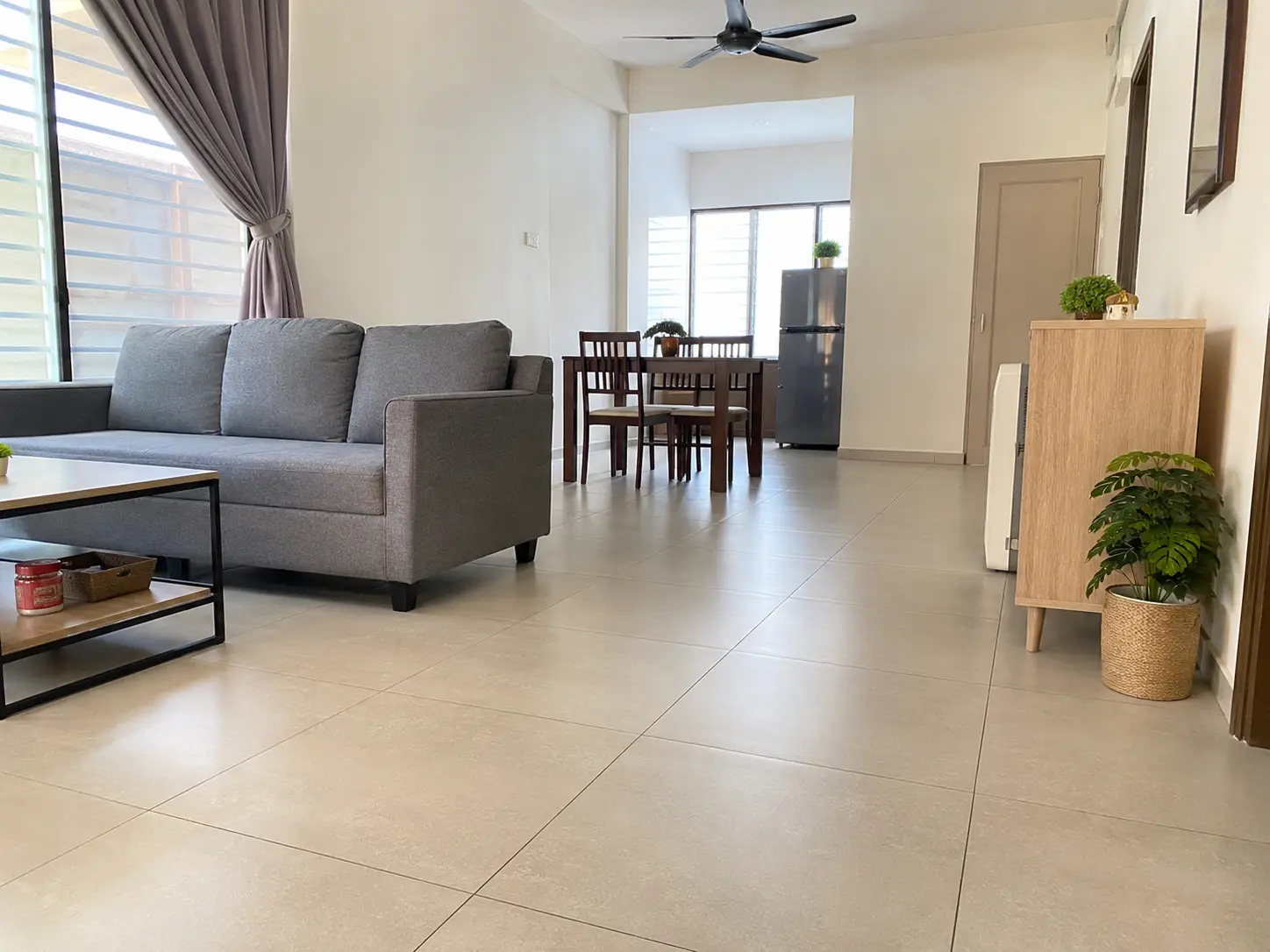
Floor Tiles in Kuala Lumpur & Selangor: Ceramic, Porcelain, Homogeneous and Natural Stone
Floor tiling is still the default flooring choice for most Malaysian homes, and for good reason - it's hard-wearing, handles humidity and spills without a second thought, and covers everything from a budget ceramic refresh to a premium natural stone living area. My Reno Service installs floor tiles for condos, apartments and landed homes across KL, Selangor and the wider Klang Valley, from living areas and kitchens through to balconies and car porches.
There isn't one "best" floor tile. A kitchen has different demands from a bedroom, and a condo renovation comes with different constraints than a landed house. Budget matters too, and so does how much disruption you're prepared to live with while the work is happening.
Send us photos of the room you're retiling, roughly how large the area is, and your budget range, and we'll help you work out which tile type and size actually makes sense before you start comparing showroom samples.
What Does Floor Tiling Actually Cover?
Floor tiling means hacking out the existing floor where needed, laying a proper screed bed, then setting and grouting new tiles on top - ceramic, porcelain, homogeneous or natural stone, depending on the room and budget. It's the traditional route to a new floor, and still the most common one in Malaysian homes.
The main downside compared to newer options like SPC flooring is disruption. Tiling involves wet trades, dust, and a few days of drying and curing time before the floor can take full traffic. In exchange, a well-installed tile floor is permanently bonded to the substrate rather than floating on top of it, and it handles heat, water and heavy use in a way few other finishes can match.
This page covers floor tiling as a general flooring choice - living areas, kitchens, balconies and other interior or exterior spaces. For bathroom-specific tiling, including waterproofing and anti-slip requirements, see our bathroom tiles page instead.
Which Floor Tile Do You Need?
A quick starting point before the fuller breakdown below - most homeowners land in one of these four situations.
Tight budget, need it done
Ceramic tiles cover the cost and get a plain room looking fresh without stretching the renovation budget.
Busy living area or kitchen
Porcelain or homogeneous tiles hold up to daily traffic, spills and cleaning far better than budget ceramic.
Premium, statement floor
Natural stone like marble or granite gives a depth and character that printed tiles can only approximate.
Sound tiles, want less disruption
If your existing tiles are flat and sound, an SPC floating floor over the top may suit you better than retiling.
Why Floor Tiles Are Still So Popular
Tiling isn't the fastest or least disruptive flooring option anymore, but it earns its place for a handful of practical reasons.
Naturally water resistant
A properly laid and grouted tile floor handles spills, mopping and Malaysia's humidity without swelling, warping or trapping moisture underneath.
Permanently bonded, not floating
Tiles are fixed directly to the screed bed. SPC flooring, by comparison, floats above the existing floor, so there's no expansion gap to manage here and nothing to shift underfoot over time.
Handles heat and heavy use
Tiles won't scorch under a dropped pot or dent under a heavy appliance the way softer flooring can. That's especially valuable in kitchens and busy living areas.
Huge range of looks
From plain ceramic through wood-look and concrete-look porcelain to genuine marble and granite, tiling covers a wider style and budget range than most other flooring types combined.
A long service life
A well-installed tile floor commonly lasts decades with only grout maintenance, often outlasting several rounds of paint, cabinetry or furniture in the same room.
Works indoors and outdoors
Exterior-rated homogeneous and porcelain tiles extend the same look from the living area out to a balcony, patio or car porch, using one continuous flooring language.
The Main Floor Tile Types Used in Malaysian Homes
Most floor tiling jobs in Malaysia use one of four material categories. Here's how they compare before the closer look at each one below.
| Tile type | Best for | Relative cost | Note |
|---|---|---|---|
| Ceramic tiles | Budget renovations, bedrooms, lower-traffic rooms | Budget (RM4–RM10 / sq ft) | Most common and widely available option |
| Porcelain tiles | Living areas, kitchens, large-format modern looks | Mid-range (RM8–RM18 / sq ft) | Denser and more durable than ceramic |
| Homogeneous tiles | Both indoor and exterior/wet-adjacent areas | Mid-range (RM8–RM18 / sq ft) | Colour runs through the whole tile, not just a surface glaze |
| Natural stone (marble / granite) | Premium living areas and feature floors | Premium (RM18–RM45+ / sq ft) | Unique veining, needs periodic sealing |
Ceramic Tiles
Budget (RM4–RM10 / sq ft). Best for budget renovations, bedrooms and lower-traffic rooms - the most common and widely available option.
Porcelain Tiles
Mid-range (RM8–RM18 / sq ft). Best for living areas, kitchens and large-format modern looks - denser and more durable than ceramic.
Homogeneous Tiles
Mid-range (RM8–RM18 / sq ft). Best for indoor and exterior/wet-adjacent areas - colour runs through the whole tile, not just a surface glaze.
Natural Stone (Marble / Granite)
Premium (RM18–RM45+ / sq ft). Best for premium living areas and feature floors - unique veining, needs periodic sealing.
Indicative KL & Selangor pricing, reviewed 2026. These figures cover material and standard installation - hacking, screeding, laying and grouting. Not included: hacking out and disposing of an existing floor, which is usually priced separately once the site condition is known.
Ceramic Tiles
Best for: budget renovations, bedrooms and lower-traffic rooms where cost matters more than heavy-duty durability.
Ceramic tiles are made from a red or white clay body fired at a lower temperature than porcelain, then finished with a printed glaze. That glaze is where the colour and pattern sit, which keeps the manufacturing cost down and explains why ceramic is often the cheapest tile in the showroom.
The trade-off is that ceramic is more porous and generally less impact-resistant than porcelain, so it suits lower-traffic rooms better than a busy kitchen or main living area. It's still a perfectly reasonable choice for many homes, especially on a tighter budget.
Porcelain Tiles
Best for: living areas, kitchens and anywhere you want a large-format modern look with real durability.
Porcelain is made from a denser, more refined clay body fired at a higher temperature, which makes it harder and less porous than ceramic. That's also why large-format porcelain slabs are possible at all - a softer tile that size would be too fragile to handle or install.
Printed finishes have come a long way too - wood-look and concrete-look porcelain are now common alternatives to real timber flooring or exposed screed, giving a similar look with tiling's water resistance and durability built in.
Homogeneous Tiles
Best for: homes wanting one durable, consistent tile that works indoors and out.
Homogeneous tiles are dense, through-body tiles - the colour and pattern run through the entire thickness of the tile, not just a printed surface layer. So a chip or scratch doesn't expose a different colour underneath the way it can with a glazed tile.
Because of that durability, homogeneous tiles are a common choice for both indoor living areas and exterior or wet-adjacent spots like balconies and car porches, as long as an exterior-rated, slip-resistant finish is used outdoors.
Natural Stone (Marble / Granite)
Best for: premium living areas and feature floors where a genuine, one-of-a-kind material is the priority.
Marble and granite are quarried, not manufactured, so every slab has its own veining and colour variation that no printed tile can fully replicate. Granite usually shrugs off scratches better than marble. Marble wins on looks for a lot of homeowners, but it does ask for a bit more care.
Both need periodic sealing to resist staining, since natural stone is more porous than porcelain, and both sit at the top of the price range covered on this page. For homeowners chasing that specific look on a tighter budget, marble-look porcelain is often the practical middle ground.
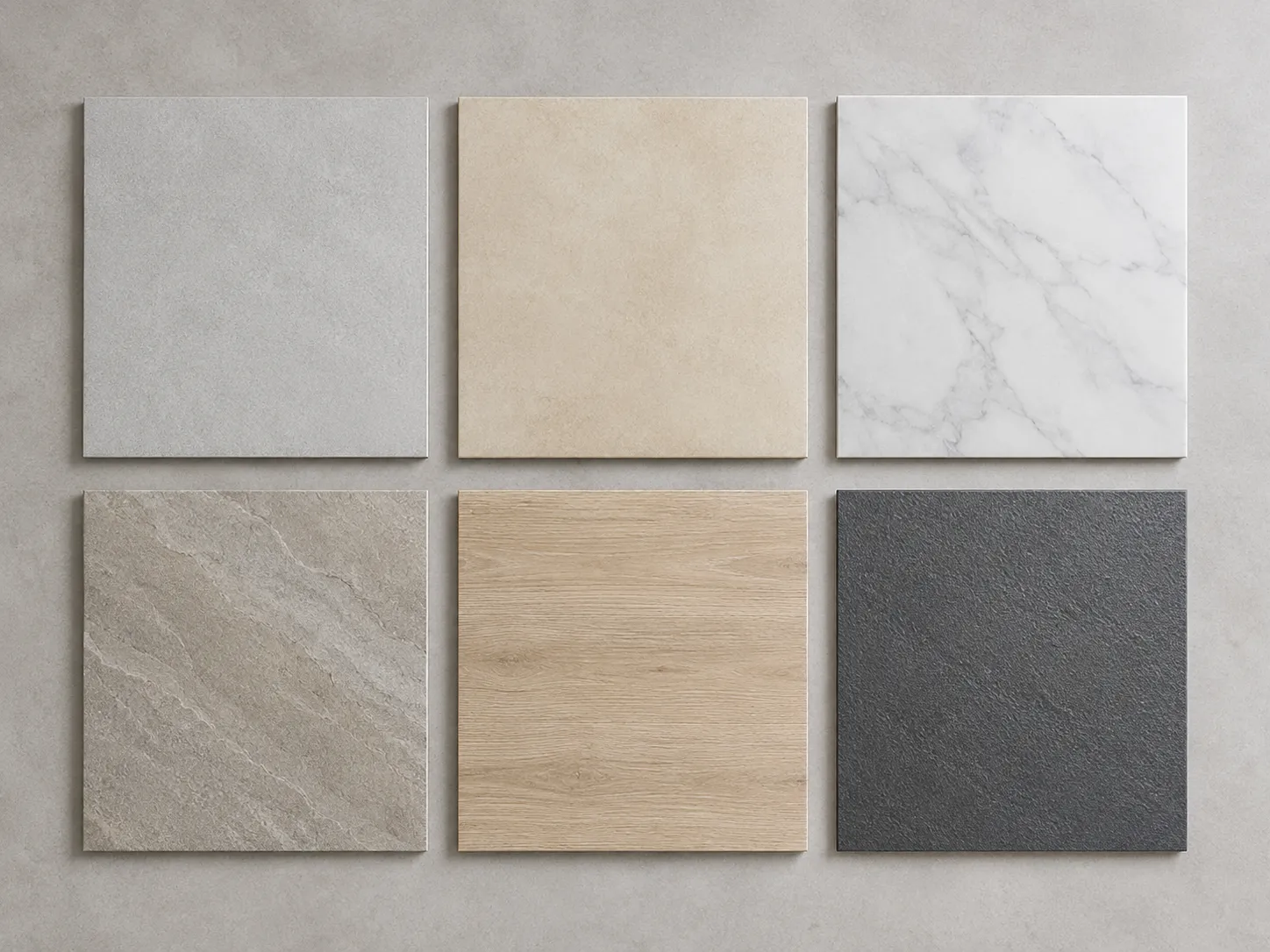
Large-format tiles are changing how tiled floors read
Printed finishes like these - stone-look, marble-look and wood-look - now cover most of the visual ground homeowners actually want, without the cost or upkeep of the natural material they're copying.
Where Floor Tiling Works Best
Floor tiling suits nearly every room in a Malaysian home, though the right tile type shifts depending on how the space gets used.
Living and dining areas
Large-format porcelain or homogeneous tiles are the most requested choice here, chosen for a clean, continuous look across an open-plan space.
Kitchens
Homogeneous and porcelain tiles handle oil, water and daily spills well - a matte or lightly textured finish is often the safer pick underfoot than high gloss.
Balconies and car porches
Exterior-rated homogeneous tiles with a slip-resistant finish and a proper drainage fall in the screed handle sun and rain well.
Ceramic vs Porcelain vs Homogeneous vs Natural Stone
A side-by-side look at how the four main tile categories compare across the factors that usually matter most when choosing.
| Factor | Ceramic | Porcelain | Homogeneous | Natural stone |
|---|---|---|---|---|
| Relative cost | RM4–RM10 / sq ft | RM8–RM18 / sq ft | RM8–RM18 / sq ft | RM18–RM45+ / sq ft |
| Durability | Moderate - fine for lower traffic | High - dense, resists chips well | High - colour runs through the tile | High, but softer marble scratches more easily than granite |
| Water resistance | Good, more porous than porcelain | Very good, low porosity | Very good, suits wet-adjacent areas | Good, but needs periodic sealing |
| Best use | Bedrooms, budget renovations | Living areas, kitchens, large-format looks | Indoor and exterior/wet-adjacent areas | Premium living areas, feature floors |
Ceramic
RM4–RM10 / sq ft. Moderate durability, good water resistance - best for bedrooms and budget renovations.
Porcelain
RM8–RM18 / sq ft. High durability, very good water resistance - best for living areas, kitchens and large-format looks.
Homogeneous
RM8–RM18 / sq ft. High durability, very good water resistance - best for indoor and exterior/wet-adjacent areas.
Natural stone
RM18–RM45+ / sq ft. High durability (varies by stone), good water resistance if sealed - best for premium living areas and feature floors.
For homeowners weighing tiling against a lower-disruption alternative, see our SPC flooring page. SPC can often click straight over existing sound tiles in days instead of weeks, but it floats above the floor rather than bonding to it, and tends to feel warmer but slightly less "solid" underfoot than tile. Which one makes more sense mostly depends on how much disruption the household can handle and whether the existing floor is a good candidate to build over.
Factors That Affect Floor Tiling Cost
The tile grade is only one part of the total cost. These factors often move the final quotation just as much.
Hacking out the old floor
Breaking out existing tiles or screed, then hauling away and disposing of the debris, is typically priced separately from the new tile and installation itself.
Screeding and levelling
A floor that's badly out of level needs extra screed thickness or corrective work before tiling, which adds material and labour.
Tile size and format
Large-format slabs need a flatter substrate and more careful handling, and typically cost more per square foot to install than a standard-size tile.
Cutting and layout complexity
Rooms with lots of corners, columns or door frames, and patterns like diagonal or herringbone tile layouts, need more cutting and take longer to lay.
Total floor area
A larger area needs more material and labour, though a whole-unit job often costs less per square foot than a single small room due to fixed setup costs.
Skirting and transitions
Skirting boards and door threshold strips are commonly priced separately but are needed for a finished look once the tiling is done.
Because so much of the cost depends on what's underneath the existing floor and how level it is, we generally can't give an accurate number without seeing it first. A site visit lets us check the substrate and existing tiles properly, which is usually the difference between a rough estimate and a quotation you can actually plan around.
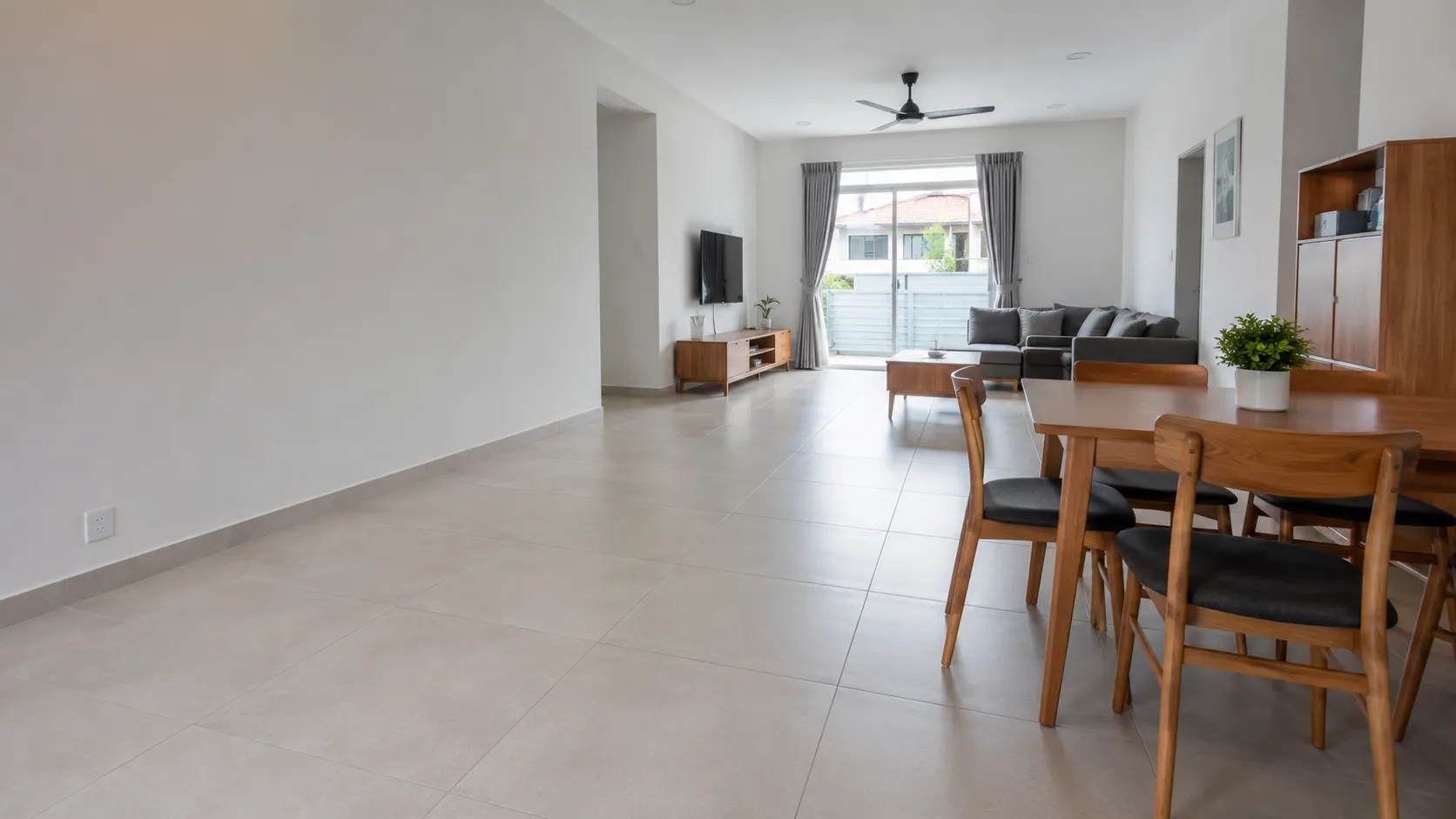
Not every job needs a premium finish to look considered
A straightforward mid-range tile, laid properly with consistent grout lines, still gives a condo living space like this a clean, put-together look - the finish quality usually matters more than the price tier.
Our Floor Tiling Process
A clear process from first message to final inspection, so you know what to expect at each stage before committing to a tile.
Initial consultation
Share your room photos, rough floor area and the look you're considering, along with your budget range and timeline.
Site visit
We check the existing floor, substrate condition and levelness, and confirm whether the old tiles need to be hacked out first.
Measurements
Before anyone orders tiles, we measure everything properly. That lets us work out quantities, minimise wastage and decide where the cuts and joints will fall.
Tile selection
Together we'll compare ceramic, porcelain, homogeneous and natural stone options to find the right balance of look, durability and budget.
Quotation
A detailed quotation is prepared covering the confirmed tile, hacking and disposal if needed, screeding, and skirting requirements.
Hacking and screeding
The old floor is broken out and removed where needed, then a level screed bed is laid and left to cure before tiling starts.
Tiling and grouting
Tiles are laid to the confirmed layout, left to set, then grouted with proper joint spacing and expansion gaps at the walls.
Final inspection
We walk through the finished floor with you, checking level, grout lines and finishing details before considering the job complete.
What to Prepare Before a Site Visit
Photos of the current floor
Clear photos of the existing tiles or flooring, including any cracked, hollow or stained sections.
A rough floor area
An approximate square footage for the room or unit, even a rough estimate helps us scope the visit.
Any tile inspiration
Reference photos or showroom names for a look you like, so we can advise on suitable, in-stock alternatives.
Your management's renovation rules
If you're in a condo or apartment, check your JMB's work-hour restrictions and approval process for hacking work ahead of time.
Common Floor Tiling Mistakes to Avoid
A few recurring mistakes cause most of the regret homeowners feel after a tiling job.
Skipping proper screeding for large-format tiles
Big tiles are less forgiving of an uneven base than small ones. A rushed or skipped levelling step often shows up later as lippage - an edge sitting slightly higher than its neighbour - or as cracking under a point load.
Choosing a glossy finish for a busy or wet area
A high-gloss tile looks sharp in the showroom, but it gets noticeably slippery once wet. That matters more in a kitchen or exterior area than most homeowners expect until it's laid.
Tiling straight over a damaged old floor
Laying new tiles over old ones without addressing hollow, cracked or uneven sections underneath just moves the problem up a layer, and it often shows through in the new floor within a year or two.
Not budgeting for hacking and disposal
Homeowners sometimes compare a tile-only quote against a full quote that includes hacking, screeding and disposal, which makes the tile-only number look artificially cheap.
Skipping JMB or management approval
Hacking work is loud and dusty enough that most condos require prior notice and a defined work-hour window - starting without approval is one of the more common causes of a paused or fined renovation.
When We Wouldn't Recommend Retiling
Tiling is a strong, durable choice for most rooms, but it isn't automatically the right answer for every situation. These are the cases where we'd usually raise an alternative.
Existing tiles are already flat and sound
If the current floor is level, undamaged and just visually dated, an SPC floating floor over the top is often a faster, cheaper and less disruptive option than hacking it out to retile.
A very tight renovation timeline
Hacking, screeding, curing and grouting all take time. If the schedule genuinely can't accommodate several days of wet trades and drying, a floating floor is often more realistic.
Strict condo noise-hour and approval limits
Some buildings restrict hacking work to a narrow window or a limited number of days, which can make a full retile impractical within the allowed timeframe.
Wanting a warmer, quieter floor
If comfort underfoot and sound dampening matter more than tiling's durability, a warmer material like SPC flooring or real wood flooring tends to suit bedrooms and living areas better than hard tile.
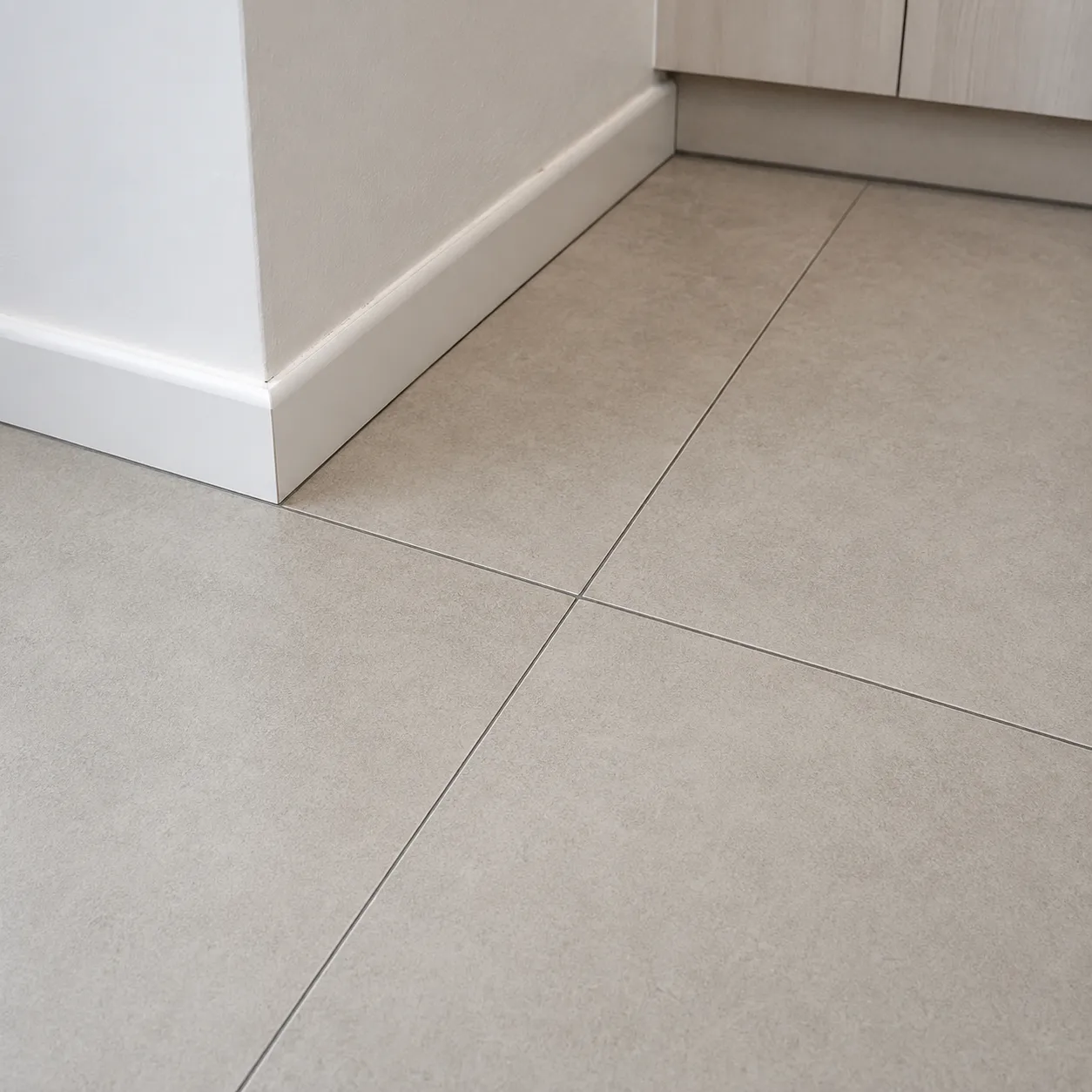
A straight grout line is harder to get than it looks
Up close, this is what good tiling actually looks like - even spacing, a straight run into the skirting, and no lippage between tiles. It's a small detail, but it's often the first thing that gives away a rushed installation.
Three Common Floor Tiling Scenarios
The budget-conscious refresh
A homeowner with cracked, mismatched ceramic tiles in a terrace house wants a clean, affordable update. The old tiles are hacked out, the floor re-screeded, and new mid-range ceramic tiles laid across the living and dining area.
The open-plan condo upgrade
A condo owner wants their living, dining and kitchen to feel like one continuous space. Large-format porcelain tiles in a concrete-look finish are laid throughout, minimising grout lines across the open-plan layout.
The premium feature floor
A bungalow owner wants the main living area to feel distinctly higher-end than the rest of the home. Natural marble tiles go down in the living room, while durable homogeneous tiles cover the rest of the ground floor.
Why Homeowners Work With Us for Floor Tiling
Tiling looks straightforward until the substrate isn't level or the layout doesn't account for door swings and furniture placement. Getting those details right is what separates a floor that lasts from one that needs redoing.
Clear scope and detailed quotations
You'll know what tile, hacking, screeding and finishing is included before work starts, not just a lump-sum number.
Honest advice on tile vs alternatives
If your existing floor is a good candidate for SPC flooring instead, we'll tell you upfront rather than sell a full retile you don't need.
Careful screeding and levelling
Proper substrate prep is what prevents lippage and cracking later, especially with large-format tiles - it's not a step we skip to save time.
A transparent process
From the first site visit through to final inspection, you'll know what's happening at each stage rather than waiting for a surprise at the end.
For homeowners planning flooring as part of a larger project, this pairs naturally with a full home renovation, a condo renovation, or a kitchen renovation - flooring is usually easiest to plan alongside skirting, cabinetry and lighting rather than as a standalone job. If bathroom tiling is what you're after, see our dedicated bathroom tiles page, or if you're weighing this against a lower-disruption option, see our SPC flooring page. For our full list of standalone upgrades, see individual renovation services.
Floor Tiles Malaysia FAQs
What's the difference between ceramic and porcelain floor tiles?
Both are fired clay tiles, but porcelain is made from a denser, more refined clay body and fired at a higher temperature, which makes it harder, less porous and generally more durable. Ceramic tiles are usually cheaper and perfectly fine for lower-traffic areas, while porcelain tends to be the better choice for busy living areas, kitchens and anywhere that sees a lot of foot traffic or moisture.
How much do floor tiles cost in Malaysia?
As a rough guide, ceramic tiles run around RM4–RM10 per sq ft, porcelain and homogeneous tiles around RM8–RM18 per sq ft, and natural stone like marble or granite from RM18–RM45+ per sq ft. These figures cover material and standard installation - hacking out an existing floor, screeding and disposal are usually quoted separately once the site condition is known.
Do I need JMB or management approval to retile my condo floor?
In most condos and apartments, yes - and the case for getting approval first is stronger for tiling than for something like SPC flooring. Hacking out an old floor is loud, dusty and can take several days, so most JMBs and management corporations require prior notice, a defined work-hour window and sometimes a refundable renovation deposit before hacking work can start. Skipping this step is one of the more common causes of a paused or fined renovation.
Do old tiles need to be hacked out before retiling?
Generally, yes. Unlike SPC flooring or a floating floor, tiles need a proper screed bed to bond to, so laying new tiles directly over old ones is usually not recommended - it raises the floor level, can trap moisture underneath, and the old grout lines and any hollow spots underneath will often still show through or cause the new tiles to crack over time. Hacking out the old floor first, then screeding and relaying, gives a far more reliable result.
What size floor tiles are popular in Malaysian homes right now?
Large-format tiles - typically 600mm x 600mm and up, including big slab formats over 1000mm - have become the most requested option for living areas and open-plan spaces, mainly because fewer grout lines read as cleaner and more contemporary. Standard formats like 300mm x 300mm or 300mm x 600mm are still common for kitchens, smaller rooms and budget-conscious jobs where cutting and wastage matter more.
How much maintenance do grout lines actually need?
More than most homeowners expect. Grout is porous, so it can pick up dirt, oil and mould over time, especially in kitchens and high-traffic areas. A periodic scrub with a grout-safe cleaner keeps it looking fresh, and sealing the grout every year or two slows down staining considerably. Homogeneous and porcelain tiles with tighter grout lines generally need less upkeep than smaller-format tiles with more joints.
What's the risk with large-format tiles specifically?
More than anything else, they expose bad preparation. If the screed underneath isn't flat enough, you'll notice uneven edges between tiles - what installers call lippage - and a big tile is also less forgiving of a soft spot or point load than a small one, since there's less flex across the surface. That's why experienced installers spend so much time getting the base right before a single large-format tile goes down.
Are floor tiles suitable for kitchens?
Yes - tiles are one of the most common kitchen floor choices in Malaysia, particularly homogeneous and porcelain tiles, since both hold up well against water, oil and daily spills. A matte or lightly textured finish is usually a better call than a high-gloss tile underfoot in a kitchen, since glossy surfaces get slippery once wet or oily.
Are floor tiles suitable for outdoor or semi-outdoor areas like a balcony or car porch?
Homogeneous and select porcelain tiles rated for exterior use work well outdoors, but the tile has to be properly rated for outdoor use with proper slip resistance - an indoor-finish tile laid outside can become dangerously slippery in the rain. Outdoor tiling also needs a drainage fall built into the screed so water doesn't pool. See our car porch renovation page for more on exterior flooring specifically.
How long does floor tiling take to install?
For a single room, hacking, screeding, laying and grouting usually takes around 3 to 7 days, depending on room size and whether the old floor needs breaking out first. A full-unit retiling job across a condo or terrace house commonly runs 1 to 3 weeks, plus a few extra days of curing time before the floor takes full foot traffic and furniture.
Is natural stone flooring worth the extra cost over porcelain?
It depends on what you're after. Natural stone like marble or granite has a depth and variation that printed porcelain can only approximate, and it can add real value to a higher-end home. The trade-off is cost, periodic sealing to prevent staining, and the fact that no two slabs are identical, which some homeowners love and others find harder to plan around than a consistent porcelain pattern.
Should I choose floor tiles or SPC flooring?
It comes down to how much disruption you can tolerate and what look you want. Tiling means hacking, screeding and drying time, but you end up with a hard, cold-resistant floor that's bonded to the substrate for good. SPC is quicker and less disruptive, and can often go straight over existing sound tiles, but it floats above the floor rather than bonding to it. See our SPC flooring page for a full comparison.
Can floor tiles crack over time, and can they be repaired?
Yes, usually from a heavy impact, a poorly screeded substrate, or structural movement in the building. A single cracked tile can often be replaced individually if a spare from the original batch is kept, though colour can vary slightly with tiles bought later. Widespread cracking usually points to a substrate problem that needs addressing before retiling, not just swapping out the damaged pieces.
Ready to plan your floor tiling?
Send us a few photos of the room, your rough floor area and your budget range. We'll help you understand what's realistic - including whether the existing floor needs to be hacked out first - before you commit to a tile.