
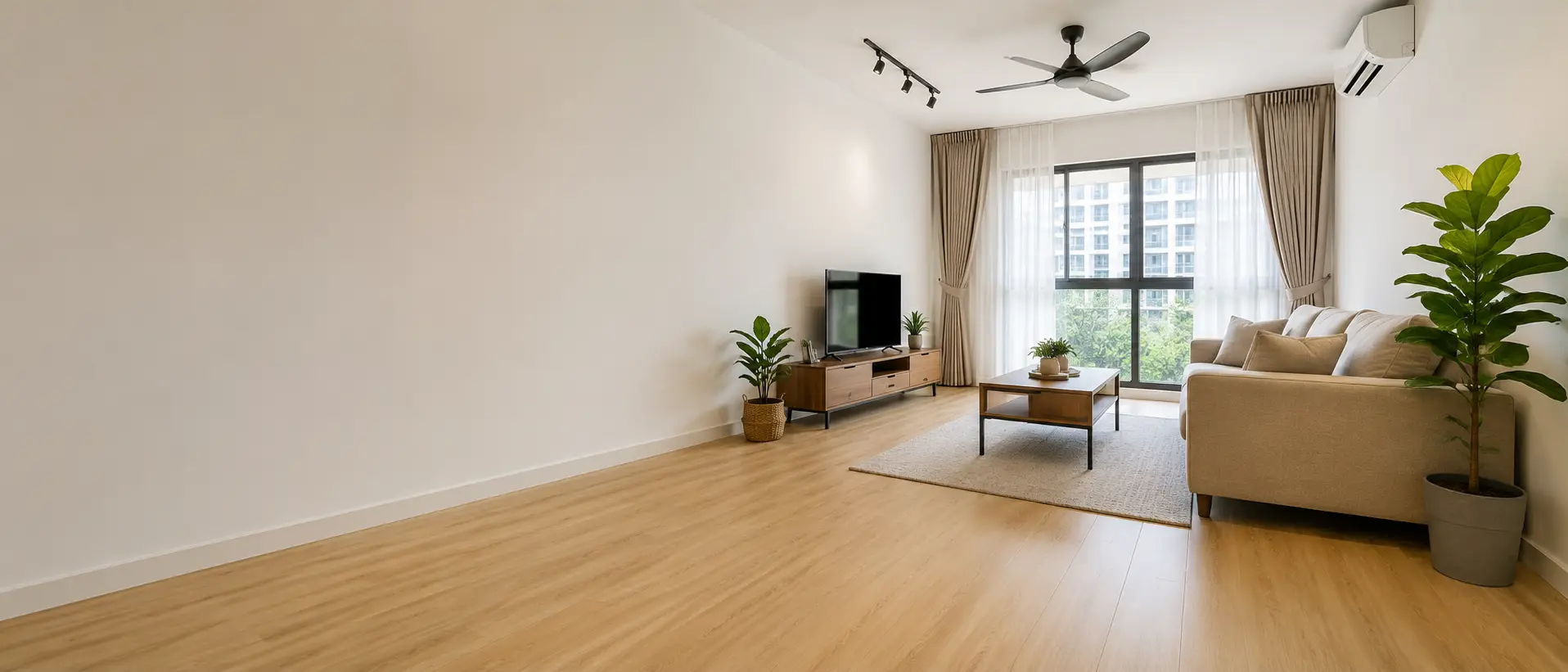
Vinyl Flooring in Kuala Lumpur & Selangor: Types, Installation and Cost
Vinyl flooring is one of the quickest, most affordable ways to transform a room - sheet, click-lock tile or plank, and thicker WPC options all install fast, often straight over existing sound flooring. My Reno Service installs vinyl flooring for condos, apartments and landed homes across KL, Selangor and the wider Klang Valley.
A rental unit on a tight budget and a family home wanting a warmer, quieter floor rarely call for the same vinyl. Subfloor condition, how much daily wear the room sees, and how long you plan to keep the floor all shape what actually makes sense before you start comparing samples.
Send us photos of the room and existing floor, roughly how much area is involved, and your budget range, and we'll help you work out which vinyl format actually makes sense before you commit to a material.
What Is Vinyl Flooring?
Vinyl flooring is a PVC-based floor covering that comes in three main formats: large continuous sheets, individual click-lock or glue-down tiles and planks (often sold as LVT - luxury vinyl tile), and thicker WPC vinyl with a semi-rigid wood-plastic composite core. All three sit on top of the existing floor rather than bonding permanently into it the way tile does.
Compared to SPC flooring, standard vinyl is thinner, more flexible and generally cheaper, so it's easier to cut around awkward corners and pipework. The downside is that it's less forgiving of an uneven subfloor and softer underfoot, so it dents more easily under heavy furniture.
This page covers standard and WPC vinyl flooring specifically. For the rigid-core version with better dent resistance and subfloor tolerance, see our SPC flooring page instead.
Which Vinyl Flooring Do You Need?
A quick starting point before the fuller breakdown below - most homeowners land in one of these four situations.
Renting or on a tight budget
Sheet vinyl or budget click-lock tile gives a real visual upgrade for the lowest material cost on this page, and can often be lifted again later.
Want an affordable wood look
Click-lock vinyl plank (LVT) in a wood-look print is the most requested format for bedrooms and living areas wanting a warm finish without timber pricing.
Want a warmer, quieter floor
WPC vinyl's thicker semi-rigid core gives a softer, quieter feel underfoot than SPC or tile, while staying more stable than standard sheet or thin tile.
Uneven floor, want more durability
If the existing floor isn't perfectly flat or furniture dents are a concern, SPC's rigid core is usually the better fit - see our SPC flooring page.
Benefits of Vinyl Flooring
Vinyl has become one of the most popular flooring choices in Malaysia for a few simple reasons.
Fast, low-mess installation
Most rooms can be back in use within a day or two, since click-lock vinyl floats above the existing floor without hacking, wet trades or long curing time.
The most affordable flooring upgrade
Sheet and standard click-lock vinyl sit at the lower end of the cost range compared to SPC, tile or timber, making it an accessible option for budget-conscious projects.
A huge range of prints and formats
Wood-look, stone-look and plain colour options are all available across sheet, tile and plank formats, covering a wide style range at a low cost per look.
Handles Malaysia's humidity well
PVC doesn't absorb moisture or swell the way timber can. That's one reason vinyl performs well across humid Malaysian homes, as long as the subfloor underneath is properly dry.
Softer and quieter underfoot
Standard and WPC vinyl have more give than SPC, tile or timber - a real difference on a groggy morning walk across the floor, and noticeably warmer and quieter underfoot, especially in bedrooms.
Easy to replace or update later
Click-lock vinyl can often be lifted and swapped section by section without disturbing the whole floor, which suits rental units and homeowners who expect to update again later.
The Main Vinyl Flooring Formats Used in Malaysian Homes
Most vinyl flooring jobs in Malaysia use one of these formats. Here's how they compare before the closer look at each one below.
| Format | Best for | Relative cost | Note |
|---|---|---|---|
| Sheet vinyl | Budget rentals, near-seamless large areas | Budget (RM3–RM6 / sq ft) | Fewest seams, but harder to repair a damaged section |
| Click-lock vinyl tile / plank (LVT) | Bedrooms, living areas, wood-look finishes | Budget–Mid (RM5–RM9 / sq ft) | Floats over existing floor, fastest standard install |
| Glue-down vinyl | Rooms with heavier furniture or rolling chairs | Mid (RM6–RM11 / sq ft) | Firmer underfoot feel, more involved to remove later |
| WPC vinyl | Warmer, quieter floors with more stability | Mid (RM8–RM13 / sq ft) | Thicker semi-rigid core, sits between standard vinyl and SPC |
Sheet Vinyl
Budget (RM3–RM6 / sq ft). Best for budget rentals and near-seamless large areas - fewest seams, but harder to repair a damaged section.
Click-Lock Vinyl Tile / Plank (LVT)
Budget–Mid (RM5–RM9 / sq ft). Best for bedrooms, living areas and wood-look finishes - floats over existing floor, fastest standard install.
Glue-Down Vinyl
Mid (RM6–RM11 / sq ft). Best for rooms with heavier furniture or rolling chairs - firmer underfoot feel, more involved to remove later.
WPC Vinyl
Mid (RM8–RM13 / sq ft). Best for warmer, quieter floors with more stability - thicker semi-rigid core, sits between standard vinyl and SPC.
Indicative KL & Selangor pricing, reviewed 2026. These figures cover material and installation for a sound, ready subfloor. Not included: subfloor levelling, skirting, and removal and disposal of an existing floor, which are usually priced separately once the site condition is known.
Sheet Vinyl
Best for: budget rentals and large open areas where minimal seams and the lowest material cost matter most.
Sheet vinyl comes in large rolls, typically 2-4 metres wide, and is laid across a room with as few seams as possible, sometimes heat-welded or taped for an almost seamless surface. That makes it close to fully waterproof across the sheet, and one of the cheapest ways to cover a large area.
The catch is repairability - if one section is damaged, it's harder to patch cleanly compared to lifting and replacing a single tile or plank, so sheet vinyl suits rooms where a uniform look matters more than easy spot repairs.
Click-Lock Vinyl Tile / Plank (LVT)
Best for: bedrooms, living areas and anyone wanting an affordable wood-look or stone-look finish.
Individual tiles or planks click together along their edges and float above the existing floor without adhesive, similar to how SPC and laminate install. This is the most commonly requested vinyl format in Malaysian homes, largely because of how quick and low-mess the installation is.
Because each piece floats independently, a damaged plank can usually be lifted and swapped without redoing the whole floor - a practical advantage over sheet vinyl for rooms that see daily wear.
Glue-Down Vinyl
Best for: rooms with heavier furniture, rolling office chairs, or where a firmer underfoot feel is preferred.
Glue-down vinyl is fixed directly to the subfloor instead of floating above it. It feels slightly firmer and less hollow-sounding underfoot, and copes with heavy furniture legs a little better than a floating floor.
The downside is installation takes longer, since the adhesive needs time to cure before the floor takes furniture, and it's considerably more involved to remove or replace later than click-lock vinyl.
WPC Vinyl
Best for: homeowners wanting a warmer, quieter floor with more stability than standard vinyl, without SPC's fully rigid feel.
WPC stands for wood-plastic composite - the core is thicker and semi-rigid, giving more cushioning and sound dampening than standard sheet or tile vinyl, while still being softer and quieter underfoot than SPC.
WPC costs more than standard vinyl but less than many premium SPC options, making it a good middle ground for bedrooms and living areas where comfort underfoot matters as much as durability.
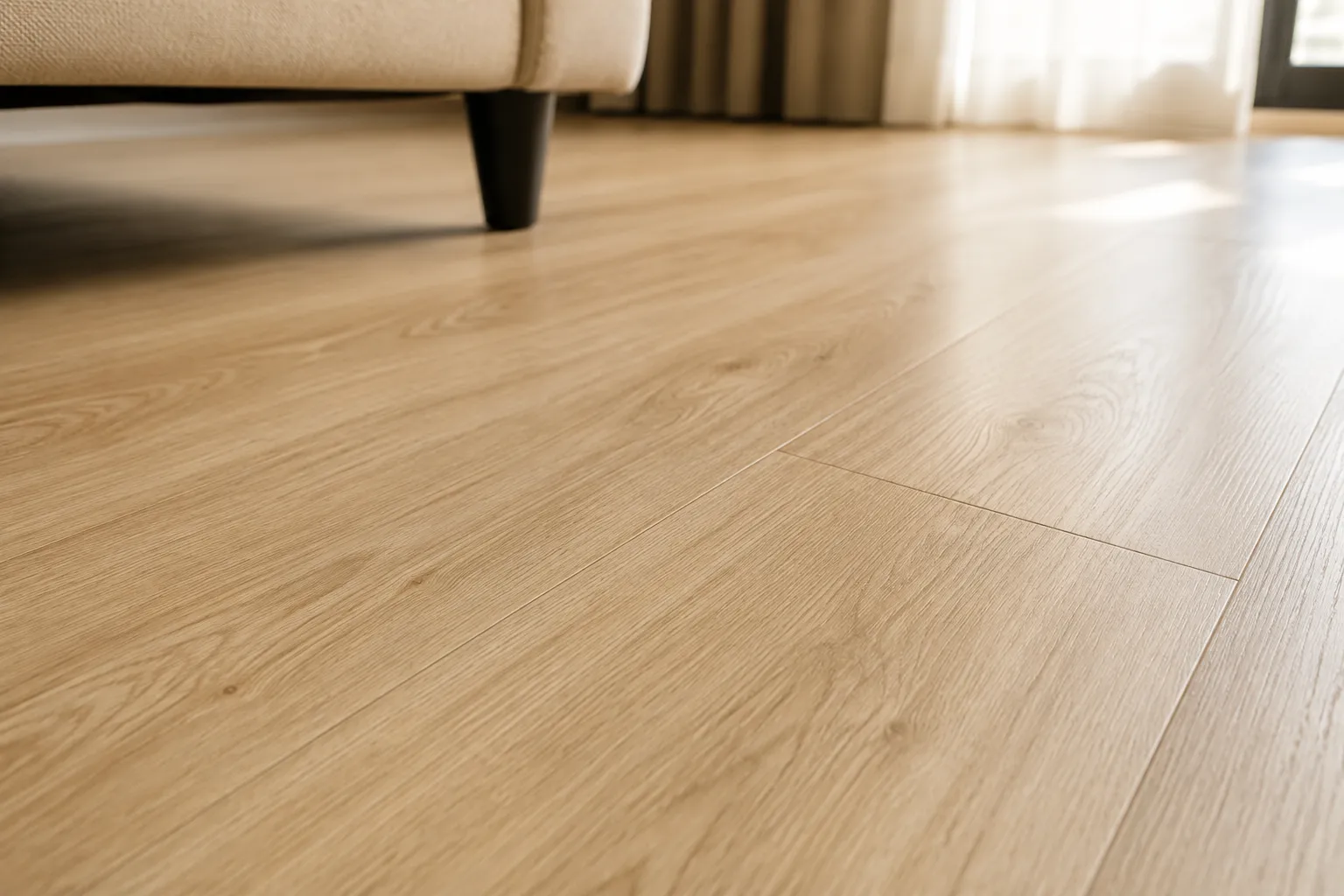
A wood-look plank floor without the timber price tag
Up close, a well-made vinyl plank can look surprisingly similar to real timber, right down to the grain and knot detail, at a fraction of solid or engineered wood's cost - the seams between planks are usually the only giveaway, and even those sit flush when installed properly.
Where Vinyl Flooring Works Best
Vinyl suits most dry interior spaces, though the right format shifts depending on how the room is used.
Bedrooms
Click-lock vinyl plank or WPC vinyl gives a warm, quiet floor underfoot, which is usually the priority over sheer durability in a bedroom.
Living and dining areas
Larger-format click-lock plank in a wood-look or stone-look finish gives a clean, continuous look across open-plan spaces at a lower cost than SPC or tile.
Rental and short-term units
Sheet or budget click-lock vinyl gives a real visual refresh at low cost, and click-lock can often be lifted again if the unit changes hands.
Vinyl vs SPC vs Laminate
Vinyl, SPC and laminate often get shortlisted together. Here's how they compare across the factors that usually matter most.
| Factor | Vinyl | SPC | Laminate |
|---|---|---|---|
| Relative cost | RM3–RM13 / sq ft | RM5–RM18 / sq ft | RM4–RM12 / sq ft |
| Waterproof | Mostly, depending on format and seams | Fully waterproof rigid core | Not waterproof - core swells if wet |
| Handles uneven floors | Shows unevenness more easily | Hides minor unevenness well | Moderate, needs a flat base |
| Underfoot feel | Soft and quiet | Firm and stable | Firm, can sound hollow |
Vinyl
RM3–RM13 / sq ft. Mostly waterproof depending on format - soft and quiet underfoot, shows subfloor unevenness more easily.
SPC
RM5–RM18 / sq ft. Fully waterproof rigid core - firm and stable, hides minor subfloor unevenness well.
Laminate
RM4–RM12 / sq ft. Not waterproof - firm underfoot, needs a flat subfloor base.
If subfloor condition or long-term durability is the deciding factor rather than upfront cost, our SPC flooring page covers the rigid-core alternative in full detail.
Factors That Affect Vinyl Flooring Cost
The vinyl format you choose is only one part of the total cost. These factors often move the final quotation just as much.
Subfloor condition
A floor that's badly out of level or has loose, hollow sections needs levelling compound or patching first, which adds cost before the vinyl itself goes down.
Removal of the existing floor
If the current flooring isn't a suitable base to install over, taking it out and disposing of it is usually priced separately from the new vinyl.
Format and install method
Sheet vinyl, click-lock and glue-down each have different labour requirements, and glue-down needs cure time factored into the schedule.
Total floor area
A larger area needs more material and labour, though a whole-unit job often costs less per square foot than a single small room due to fixed setup costs.
Room shape and cutting complexity
Rooms with lots of corners, columns or door frames need more cutting and wastage, which adds time and material beyond a simple rectangular room.
Skirting and transitions
Skirting boards and door threshold strips are commonly priced separately but are needed for a finished look once the flooring is done.
Until we see the existing floor, any number is only a rough estimate. A site visit lets us check the subfloor properly and give you a quotation based on the actual condition, not guesswork.
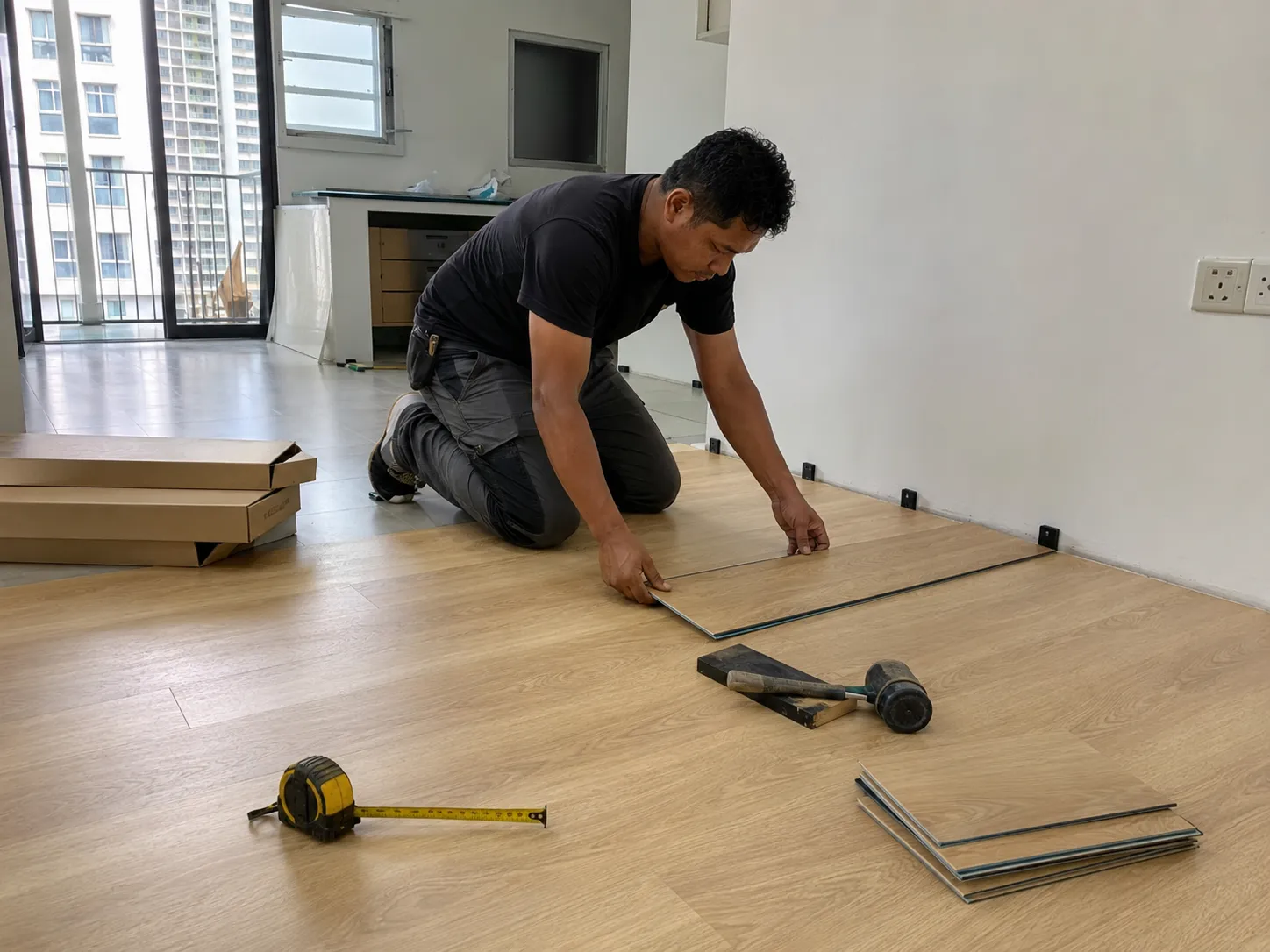
Click-lock installation is quick, but the details still matter
Spacers along the wall keep the expansion gap consistent as each plank clicks into place - a small step that's easy to skip, but it's what stops the floor from buckling months later once the room has settled into daily use.
Our Vinyl Flooring Process
A clear process from first message to final walkthrough, so you know what to expect at each stage before committing to a material.
Initial consultation
Share photos of the room and existing floor, your rough floor area, and the look you're considering, along with your budget range.
Site visit
We check the existing floor and subfloor condition, and confirm whether it's a suitable base to install over or needs prep work first.
Measurements
We measure the room properly to work out quantities, minimise wastage and plan where seams or plank joints will fall.
Format and material selection
Together we'll compare sheet, click-lock, glue-down and WPC options to find the right balance of feel, durability and budget.
Quotation
A detailed quotation is prepared covering the confirmed material, any subfloor prep or old flooring removal, and skirting requirements.
Subfloor preparation
The existing floor is cleaned, levelled or patched as needed so the new vinyl has a sound, even base to sit on.
Installation
The vinyl is laid to the confirmed layout - click-locked, glued or seam-welded depending on the format - and skirting is fitted.
Final walkthrough
We walk through the finished floor with you, checking seams, edges and finishing details before considering the job complete.
What to Prepare Before a Site Visit
Having a few things ready before we visit makes the assessment faster and the quotation more accurate.
Photos of the current floor
Clear photos of the existing floor, including any cracked, hollow or uneven sections, help us assess whether it's a good base to install over.
A rough floor area
Even an approximate square footage for the room or unit helps us scope the visit.
Any style inspiration
Reference photos or showroom names for a look you like, so we can advise on suitable, in-stock alternatives.
Your management's renovation rules
If you're in a condo or apartment, check your JMB's approval process and any notice period for flooring work ahead of time.
Common Vinyl Flooring Mistakes to Avoid
A few recurring mistakes cause most of the regret homeowners feel after a vinyl flooring job.
Skipping subfloor prep on an uneven floor
Vinyl is thinner and more flexible than SPC or tile, so bumps, dips and old grout lines show through more readily if the subfloor isn't levelled first.
Installing over a damp or unsealed slab
Laying vinyl over a concrete slab that hasn't been checked for moisture can trap dampness underneath, which may affect the adhesive or click joints over time.
Choosing the thinnest option for a heavy-furniture room
Budget sheet or thin click-lock vinyl dents more easily under heavy sofas, dining tables and appliances - a thicker WPC or SPC floor usually holds up better in these rooms.
Not leaving an expansion gap
Click-lock vinyl needs a small gap at the walls to allow for natural expansion and contraction - skipping this can cause the floor to buckle over time, especially in larger rooms.
Skipping JMB or management notice
Even though vinyl installation is low-mess, some buildings still require advance notice or a permit before flooring work starts - checking first avoids delays on installation day.
When We Wouldn't Recommend Vinyl
Vinyl is a strong, affordable choice for many rooms, but it isn't automatically the right answer for every situation. These are the cases where we'd usually raise an alternative.
The subfloor is noticeably uneven
Standard vinyl shows dips and bumps more than a rigid floor does. If the existing floor isn't flat and levelling isn't in the budget, SPC usually hides the problem better.
Heavy furniture or commercial-grade traffic
Standard vinyl dents more easily than SPC or tile under sustained heavy loads, so rooms that need to shrug off furniture and daily wear are usually better served by a rigid floor.
Long-term resale value is the priority
Natural stone, timber or tile carry more weight with some buyers than vinyl. If resale premium matters more than upfront cost, it's worth comparing against those options too.
A genuinely wet or flood-prone area
Sheet vinyl handles splashes well, but click-lock vinyl's joints aren't a substitute for a fully sealed wet-area floor. SPC or tile is the more reliable choice here.
Three Common Vinyl Flooring Scenarios
The rental unit refresh
A condo owner preparing a unit for rent wants a quick, affordable visual upgrade over sound existing tiles. Budget click-lock vinyl plank goes down across the living area and bedrooms in a day, giving the unit a noticeably fresher look for the next tenant. A unit this size typically lands in the RM2,500-RM4,500 range.
The bedroom wood-look upgrade
A homeowner wants a warmer floor in a bedroom currently finished in cold, glossy tile. Wood-look click-lock vinyl plank is installed directly over the existing tile, taking half a day and giving the room a noticeably softer, quieter feel underfoot. A single bedroom typically costs RM800-RM1,800.
The whole-unit WPC upgrade
A family with young children wants a warmer, quieter floor throughout a condo without the fully rigid feel of SPC. WPC vinyl is installed across the living areas and bedrooms over three days, balancing comfort underfoot with better stability than standard vinyl. A job like this typically lands in the RM6,000-RM10,000 range.
Why Homeowners in Kuala Lumpur & Selangor Work With Us for Vinyl Flooring
Vinyl looks like a simple upgrade, but getting subfloor prep and format choice right is what separates a floor that lasts from one that needs redoing within a year.
Honest advice on vinyl vs SPC
If your subfloor or furniture situation calls for SPC's added durability instead, we'll tell you upfront instead of selling you the cheaper option regardless of fit.
Proper subfloor checks before quoting
We check moisture and levelness before recommending a format, rather than assuming any floor is a safe base to install over.
Clear scope and detailed quotations
Material, prep work and skirting are listed as separate line items in the quotation, so you know exactly what you're paying for before work starts.
Fast turnaround with no wasted site visits
Since vinyl involves no hacking or wet trades, most jobs move from quotation to a finished floor in days, not weeks.
For homeowners weighing vinyl against a more durable rigid-core option, see our SPC flooring page. For a harder, permanently bonded floor, our floor tiles, wood flooring and cement screed flooring pages cover those alternatives.
See our full list of individual renovation services if you're weighing this against other standalone upgrades.
Vinyl Flooring Malaysia FAQs
What is vinyl flooring made of?
Vinyl flooring is built from layers of PVC (polyvinyl chloride), usually a base layer, a printed design layer, and a clear wear layer on top that protects the print from scuffs and fading. It comes as sheet vinyl in large rolls, or as individual vinyl tiles and planks (often called LVT - luxury vinyl tile) that click together or glue down.
How much does vinyl flooring cost in Malaysia?
As a rough guide, sheet vinyl runs around RM3-RM6 per sq ft, click-lock vinyl tile or plank (LVT) around RM5-RM9 per sq ft, and WPC vinyl with a thicker, semi-rigid core around RM8-RM13 per sq ft. These figures cover material and standard installation only - subfloor levelling, skirting and removing old flooring are usually quoted separately.
What's the difference between vinyl flooring and SPC flooring?
SPC is technically a type of rigid vinyl flooring, so standard vinyl is really the flexible, thinner end of the same family. Standard vinyl sheet or tile is cheaper and easier to cut around awkward corners, but it shows subfloor imperfections more easily and dents more readily under furniture. SPC's rigid limestone-PVC core hides minor subfloor unevenness better and holds up longer under daily wear. See our SPC flooring page for the full breakdown.
Is vinyl flooring waterproof?
It depends on the format. Sheet vinyl, laid in large continuous rolls with heat-welded or taped seams, is close to fully waterproof across the sheet itself. Click-lock vinyl tile and plank have more seams, and while the material itself doesn't absorb water, water can sit in the joints if it's not wiped up - so it handles splashes and humidity well but isn't the same as a fully sealed wet-area floor.
Can vinyl flooring be installed over existing tiles?
Usually yes, provided the existing tiles are flat, sound and free of loose or hollow sections. Click-lock vinyl floats above the old floor without needing adhesive, which is one of the main reasons homeowners choose it over retiling. A skim coat or levelling compound may be needed first if the old floor has an uneven grout line or minor dips.
Do I need JMB or management approval to install vinyl flooring in a condo?
Requirements vary by building, but vinyl flooring is generally one of the less disruptive renovation jobs to get approved, since it doesn't involve hacking or wet trades. Some JMBs and management corporations still want advance notice or a short-notice permit before any flooring work begins, so it's worth checking your building's renovation guidelines before booking an installation date.
Click-lock or glue-down vinyl - which is better?
Click-lock (floating) vinyl installs faster, doesn't need adhesive to cure, and can usually be lifted and replaced section by section if a plank gets damaged. Glue-down vinyl bonds directly to the subfloor, which gives a slightly firmer, more solid underfoot feel and suits rooms with heavier furniture or rolling chairs, but it's more involved to install and harder to remove later. Most residential jobs in Malaysia use click-lock for the faster, less messy installation.
How long does vinyl flooring last?
A mid-range click-lock vinyl or LVT floor typically lasts 8-15 years with normal household use, depending on wear layer thickness and how well it's maintained. Thinner economy sheet vinyl tends toward the shorter end of that range, while WPC vinyl with a thicker wear layer holds up toward the longer end.
Does vinyl flooring dent or scratch easily?
Standard vinyl is softer than SPC or tile, so it's more prone to denting under heavy furniture legs or dropped sharp objects, and stiletto heels can leave marks over time. Furniture pads under sofa and table legs go a long way toward preventing this. If dent resistance is the main priority, SPC or WPC vinyl with a thicker core is usually the better fit.
Is vinyl flooring suitable for humid Malaysian homes?
Yes, vinyl flooring generally handles Malaysia's humidity well since PVC itself doesn't absorb moisture or swell the way timber can. The more relevant question is usually the subfloor underneath - a damp or poorly ventilated concrete slab should be checked and allowed to dry properly before vinyl is laid, since trapped moisture under the floor can eventually affect the adhesive or click joints.
How long does vinyl flooring installation take?
For a single room, click-lock vinyl installation usually takes half a day to a day once the subfloor is ready. A full condo or apartment unit commonly takes 2-4 days. Glue-down installations and jobs that need subfloor levelling or old flooring removal first take longer, since the adhesive or levelling compound needs time to cure before the floor can take furniture.
Should I choose vinyl flooring or SPC flooring?
Mostly it comes down to your subfloor and your budget - see the question above for how the two actually differ. If the existing floor is flat and sound and cost matters most, vinyl is usually the pick. If the subfloor is uneven or the room takes heavy daily wear, SPC's extra cost tends to pay for itself. See our SPC flooring page for a full comparison if you're weighing the two.
What is a wear layer, and how thick should it be?
The wear layer is the clear top coating that protects the printed design underneath from scuffs, scratches and fading - it's the single biggest factor in how long a vinyl floor holds up visually. Budget sheet and click-lock vinyl commonly come with a 0.1mm-0.2mm wear layer, which is fine for bedrooms and lighter-traffic rooms. For living areas, rentals between tenants, or homes with pets, a 0.3mm wear layer is a safer minimum, and WPC vinyl often ships with 0.3mm-0.5mm for the best long-term wear resistance.
Which areas do you cover for vinyl flooring installation?
Vinyl flooring enquiries commonly come from Kuala Lumpur, Selangor, Petaling Jaya, Subang Jaya, Shah Alam, Puchong, Cheras, Kepong, Ampang, Klang and Kajang. Project suitability depends on property type, subfloor condition and the scope of work involved.
Ready to plan your vinyl flooring?
Send us a few photos of the room and existing floor, your rough floor area and your budget range. We'll help you understand what's realistic - including whether your current floor is a good base to install over - before you commit to a material.